- Training
- 59348 views

Paddle tennis, tennis, endurance sports: training and nutrition to boost endurance and strength, and to better cope with training sessions or competitions lasting more than two hours. Activities such as paddle tennis, tennis and other sports lasting more than two hours require a certain level of endurance as well as good strength. These disciplines can be seen as alternating between anaerobic and endurance activity. Endurance training, in particular, differs from strength training – such as full-body or bodyweight training – in terms of intensity and duration. Indeed, endurance involves exercise of low to moderate intensity over a long period, the duration of which, whilst depending on endogenous factors, is primarily influenced by the athlete’s level of fitness.
In fact, athletes, due to the adaptation processes induced by training, have a greater capacity than normal or sedentary individuals, who, by contrast, have a lower tolerance to substances that affect performance. Paddle tennis and tennis are the most popular sports these days. There are many benefits: firstly, they can serve as a social hub because of the enjoyment they provide; secondly, activities of this kind, which require a certain amount of effort, offer cardiovascular and muscular benefits (albeit to a slightly lesser extent in this case), allowing enthusiasts to have fun whilst keeping fit.
Nutrition for endurance sports
To perform effectively in these disciplines, you need to focus on improving strength and endurance. As regards nutrition, one should refer to the athlete’s diet, which must be balanced and provide, in the correct proportions, all the macro- and micronutrients necessary to meet the body’s energy requirements. A medical history, an assessment of the individual’s nutritional status and consideration of parameters such as the LAF and fitness level enable energy requirements to be determined, thereby creating the conditions necessary to improve endurance in sports such as those discussed in this article. In practice, a good breakdown might be as follows: 50–55 per cent of calorie requirements from carbohydrates, 20–25 per cent from protein and the remainder from fats, with a preference for unsaturated fats.
Training for endurance activities
An athlete’s sporting performance appears to depend 25 per cent on their genetics and 75 per cent on their training status. Training should focus in particular on improving the cardiovascular system, both in its central components – such as increasing systolic output – and in its peripheral components, as well as on ensuring the efficient functioning of the system responsible for the absorption, transport and utilisation of oxygen. Aerobic exercises are the most suitable as they improve oxygenation of the tissues involved in performance and engage a greater number of muscle groups. Cardiac adaptation can be observed through an increase in the volume of the heart chambers to accommodate a greater volume of blood, thereby allowing a greater flow of nutrients and oxygen to the muscles. Aerobic activity is performed at an intensity of 65 per cent of the subject’s maximum heart rate (HRmax).
This intensity helps to minimise the phenomenon known as fatigue, characterised by an excessive build-up of lactate in the muscles, which occurs once a certain exercise threshold is exceeded. Fundamentally, the difference between an athlete and a sedentary person lies precisely in lactate tolerance, that is to say, the greater ability of a trained individual to continue training even under conditions of acidosis.
In addition to endurance, these activities also require good strength. This can be developed through short-duration exercises at an intensity of >85% of 1 RM. Whilst it is essential to increase blood flow to the muscles involved in performance, it is equally important to improve the muscles’ ability to withstand intense exertion, which in these activities is characterised by sprints and changes of direction (in badminton and tennis, the use of rackets is also involved).
Nutritional supplements for endurance activities
To prevent drops in performance, the first factor to consider and give due attention to is hydration, which has a major impact on the activity itself. Suffice it to say that dehydration of 2–3 per cent reduces performance by around 70 per cent compared with the optimum (100 per cent). The intake of mineral salts is only recommended when water loss exceeds 3 litres, as continued physical activity increases the plasma concentration of antidiuretic hormone, which partially reduces water loss by acting on the kidneys. Good hydration ensures you can tackle a race in the best possible condition: it is recommended to drink around 400–600 ml of water approximately 30 minutes before the activity and 90–200 ml during the activity if it lasts for more than an hour.
Nutrition during a race, on the other hand, is necessary if the race lasts more than 2 hours. The aim is certainly to reduce the loss of salts (sodium and chloride are the electrolytes most commonly lost through sweating) but, above all, to prevent the depletion of glycogen, which is our main source of energy. This involves an intake of no less than 40–45 g/h and the use of rapidly absorbed, readily available sugars, either to produce energy or to partially replenish muscle glycogen.
Finally, post-exercise nutrition aims to restore the balance of all the nutrients used during exercise, which must be replenished to optimise the results achieved. Isotonic drinks are preferred to hypertonic drinks as they do not alter the water-electrolyte balance and therefore do not affect performance.
Supplements have been used in the past to enhance performance, but it is only in recent years that they have been given the recognition they deserve. For years, one of the most recognised companies on the market has been Tsunami Nutrition, synonymous with quality and innovation. Here are a few supplements – different in nature but with the same aim – that will help you perform more effectively.
- HYDROPURE PROFESSIONAL: for post-workout supplementation, there is HYDROPURE, a blend of proteins broken down into dipeptides, oligopeptides and tripeptides enriched with branched-chain amino acids. The hydrolysis process enables faster absorption, allowing the body to recover sooner.
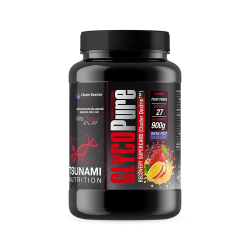
- GLYCOPURE PROFESSIONAL: Glycopure is a high-molecular-weight carbohydrate supplement containing patented CLUSTER DEXTRIN, which gives it very low osmolarity and promotes rapid gastric emptying. This helps to eliminate the gastrointestinal bloating often reported by athletes. Thanks to its molecular structure, it can be taken before training to maximise glycogen stores, during exercise to prevent drops in performance, and after training to replenish liver and muscle glycogen stores. The importance of consuming rapidly absorbed sugars after exercise (such as GLYCOPURE) stems from the fact that the rate of muscle glycogen resynthesis is highest in the first two hours following the end of the session, whereas it is reduced if carbohydrates are consumed several hours after the end of the race. Another important factor is the glycaemic index: low-GI carbohydrates prevent an increased release of insulin and thus potential episodes of hypoglycaemia.
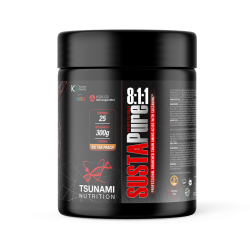
- AMMINOACID-SUSTAPURE: SUSTAPURE 8:1:1, a Tsunami product comprising branched-chain amino acids in an 8:1:1 ratio, provides valuable support for our training: 1, acting as an ‘energy buffer’ during phases of muscle catabolism and featuring a high leucine ratio, which is important for stimulating protein synthesis, and this Sustamine formula (from which the product takes its name), also known as alanyl-glutamine – composed of glutamine and alanine – which is important for nitrogen elimination but, above all, for muscle hydration, which is vital for the uptake of water and electrolytes into the cells.
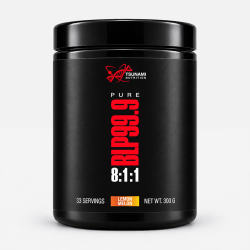
- BLP99.9 8:1:1 PURE PROFESSIONAL: Used to improve post-workout recovery, promote muscle growth and have positive effects on the immune system, BLP99.9 8:1:1 provides a complete pool of amino acids. Essential amino acids are those that the body cannot synthesise itself and must therefore obtain from the diet. After exercise, when the need is immediate, essential amino acids can be taken as a supplement for rapid absorption and to bypass time-consuming metabolic processes. BLP99.9 8:1:1 provides all the amino acids we need to initiate protein synthesis and promote muscle recovery. Furthermore, this formula also includes the addition of Sustamine, which is important for the reasons outlined above.