- Alimentation
- 27019 views

How the mTOR protein works: the two key complexes
The mTOR protein acts via two distinct complexes: mTORC1 and mTORC2, each with its own specific functions. The first, mTORC1, is responsible for protein synthesis, cell growth and lipid metabolism. It is activated in response to anabolic signals such as essential amino acids (particularly leucine), insulin and growth factors such as IGF-1. It plays a direct role in muscle hypertrophy and is central to positive adaptations to diet and training.
mTORC2, on the other hand, acts in a more subtle but no less important way: it regulates cytoskeletal organisation, ion transport and insulin sensitivity, playing a key role in the metabolic balance of the entire body. Recent studies show that an alteration in mTORC2 activity can affect muscle function and inflammation.
It is essential to understand the differences between these two complexes in order to modulate mTOR correctly to promote muscle growth, without overstimulating undesirable pathways. In other words: stimulate, yes, but intelligently.
mTOR: where is this protein found?
The mTOR protein is present in all human cells and plays a fundamental role in their growth, division and survival. It is particularly active in metabolically active tissues, such as skeletal muscle, the liver, the central nervous system and immune cells.
Its activity takes place in the cell cytoplasm, where it forms two distinct complexes: mTORC1 and mTORC2. The former has been studied more extensively due to its role in activating protein synthesis and regulating muscle growth, whilst the latter is involved in regulating cell structure and long-term metabolism.
Understanding where mTOR is located and how it acts is the first step towards understanding its importance in metabolic health, the prevention of premature ageing and the promotion of muscle adaptation to training stimuli.
mTOR, Mediator® and phosphatidic acid
Phosphatidic acid is essentially a fatty acid – more specifically, a diacylglycerophospholipid – found in cell membranes. Although it accounts for only a small proportion of the fatty acids present in the human body, it plays a vital role as a signalling molecule and precursor to other glycerophospholipids such as phosphatidylcholine and mTOR.
In recent years, thanks to research, it has been discovered that the consumption of phosphatidic acid can activate mTOR, whilst also modulating the mTORC1 complex which, as we saw at the beginning, is considered to be the ‘main regulator of skeletal muscle hypertrophy’.
In 2012, Hoffman and his colleagues studied the intake of phosphatidic acid in combination with resistance training in two different groups of athletes. They confirmed that, with the same training regime (identical for both groups), the group taking phosphatidic acid had almost doubled their muscle mass and reduced their body fat by twice as much as the placebo group.
In a second double-blind study, it was found that taking Mediator® had increased muscle mass and strength and doubled fat loss compared with those taking the placebo.
These studies had already demonstrated the potential of phosphatidic acid.
Benefits of phosphatidic acid on body composition
With regard to catabolism – that is, the loss of muscle mass – clinical studies have been conducted analysing genetic factors. It was observed that increased production of phosphatidic acid by myocytes leads to a reduction in muscle protein breakdown, thereby reducing catabolism. Furthermore, it has been observed that increased gene expression of phosphatidic acid interferes with the expression of myostatin, one of the main molecules responsible for the loss of muscle tissue.
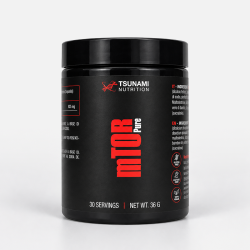
mTOR Pure Professional: how it works and why it works
In summary, taking our mTOR Pure PROFESSIONAL can:
- Increase muscle size and strength: Taking a single dose (750 mg) of Mediator® has been shown to increase strength by 12.7 per cent and lean body mass by 2.6 per cent;
- Improve fat loss and optimise body recomposition: Participants who took phosphatidic acid supplements, in combination with resistance training, lost 1.2 kg of fat mass, compared with just 500 g for the control group;
- Aiding recovery: Taking phosphatidic acid was also shown to optimise muscle recovery, a fundamental factor in lean body mass growth and maintaining a balance between protein synthesis and breakdown.
Furthermore, it is worth noting that taking phosphatidic acid has also been shown to improve cognitive function, particularly when combined with other phospholipids, notably phosphatidylserine.
Like all Tsunami Nutrition products, mTOR Pure PROFESSIONAL, which is based on Mediator® phosphatidic acid, offers high quality and bioavailability, confirming its effective absorption even when taken orally. Furthermore, it is an all-in-one product with a high safety profile (when taken at the recommended doses), non-hormonal, gluten-free and lactose-free.