- Training
- 58622 views

For years, we have tended to place greater emphasis on training solely in terms of physical performance, forgetting that the word ‘training’ encompasses other factors that are crucial to improving performance: these include warming up before each session (which is often neglected), maintaining a healthy lifestyle, and pre- and post-workout supplementation, which in turn leads to more effective recovery.
This last point, in particular, does not seem to be given enough consideration… and yet, without recovery, there is no growth.
To what extent does recovery influence muscle development?
Muscle development depends on two factors: the gradual increase in resistance (load) to ensure that muscular stress remains high, and recovery, to ensure there is sufficient rest time to repair and build‘new muscles’ that are stronger and more resilient.
During a training session, the muscles weaken due to micro-injuries caused by the increase in resistance, which prevents the athlete from continuing the exercise.
The hormone responsible for this phenomenon is cortisol, the concentration of which is particularly high during prolonged training; however, this should not be equated with a true catabolic state, as it triggers a series of processes which, in short, stimulate muscle growth (anabolism).
It can therefore be said that training and recovery are two closely linked factors; however, training two to three times a week will ensure sufficient recovery to build stronger muscle fibres, but will not lead to improved performance compared with those who train more regularly.
The aim of this article is to describe not only the importance of recovery, but also the various methods used to shorten recovery time, in order to speed up the recovery process and achieve improvements more quickly.
What can be done to ensure effective recovery?
Among the most important and effective methods are rehydration, supplementation and nutrition.
At the end of each training session, to optimise protein synthesis, the following steps should be taken: replenish lost fluids and restore fluid balance; replenish glycogen stores, which is important for limiting, or rather halting, muscle catabolism, and finally, promoting the process of protein synthesis, a concept that forms the basis of increased muscle hypertrophy.
In this regard, it is worth remembering that if one leads an unhealthy lifestyle, the measures described above will be ineffective: an unhealthy diet, alcohol, smoking and insufficient sleep will only render our efforts futile.
That said, it is possible, following the advice of experts in the field, to use supplements that support recovery processes and help you arrive ‘ready’ for your next session, whilst stimulating protein synthesis.
For years, it has been shown that the most important time for the intake of anabolic macro- and micronutrients is after training, and the best way to take advantage of this ‘anabolic window’ is to consume a liquid meal consisting of protein and carbohydrate powders immediately after training.
Protein powders are probably the most widely used supplement.

Using supplements for better recovery
The use of supplements has become commonplace to optimise recovery for those who train regularly! These supplements are made up of amino acid chains and are essential for protein synthesis; they work best when combined with powdered carbohydrates such as dextrose or another high-molecular-weight sugar.
After training, there is a significant increase in muscle insulin sensitivity: it has been observed that consuming a supplement containing protein, such as Hydro Pure Professional, and high-molecular-weight carbohydrates, such as DEXTROPURE or GLYCOPURE, facilitates the secretion of insulin, an anabolic hormone whose function is to facilitate the uptake of amino acids and glucose into muscle cells, thereby enabling, amongst other things, the restoration of muscle glycogen.
Branched-chain amino acids (BCAAs) also play an important role; they are utilised in various ways during a training session – before, during and after.
BCAAs are composed of three essential amino acids: leucine, valine and isoleucine. Leucine, in particular, has been shown to modulate the rate of protein synthesis, notably by stimulating the activity of proteins involved in the translation process, which is crucial for protein synthesis.
This modulation may involve the activation of specific intracellular pathways involved in protein synthesis, including the activation of the mammalian target of rapamycin (mTOR) pathway. It has been observed that mTOR responds immediately to any change in amino acid intake.
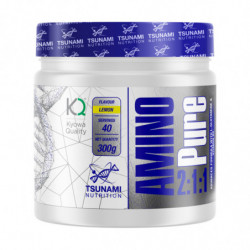
After a training session, leucine levels drop dramatically, which is why taking branched-chain amino acids such as BCAA PURE in a 4-1-1 or even 8-1-1 ratio helps to restore optimal leucine levels to ensure, together with the other essential amino acids, protein synthesis.
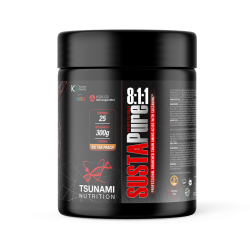
An excellent strategy recommended by Tsunami Nutrition for your training is SUSTA PURE, a product comprising branched-chain amino acids in an 8:1:1 ratio with the addition of arginine, the precursor to nitric oxide, and this sustamine formula (hence the product’s name), also known as alanyl-glutamine – composed of glutamine and alanine – which is important for nitrogen excretion but, above all, for muscle hydration, which is vital for the uptake of water and electrolytes into the cells.
The amino acids used in training are varied; amongst many others, it is possible to identify another type of non-essential amino acid, with properties similar to those of BCAAs (and in particular to those of leucine), namely glutamine or GLUTA PURE Tsunami, which is also available in peptide form—allowing for greater absorption by the body—as GLUTA PURE Peptide.
It is the most abundant amino acid in the body, where, amongst its many regulatory functions, it has an anti-catabolic effect by helping to restore muscle glycogen stores, as well as playing a direct role in protein synthesis.
The final factor to consider after training is cortisol levels, which can be restored not only with carbohydrates but also with phosphatidylserine, which Tsunami Nutrition offers in NEUROPURE, a product that reduces feelings of fatigue, maintains high testosterone levels during training and reduces cortisol levels in the blood.