- Health and wellness
- 11290 views
|
01 When |
02 Duration |
03 Safety |
04 FAQ |
|
01
|
The best time to take collagen |
The best time to take a collagen supplement depends mainly on your individual goals and daily requirements.
Hydrolysed collagen can be taken at any time of day, as the absorption of the solution does not depend on digestion following a meal. You can choose to take it in the morning on an empty stomach, or, if you prefer, in the evening after dinner.
If the product contains vitamin C, it is advisable to take it between meals, as it may cause side effects if you have a sensitive stomach.
Morning or evening: what is the best time?
There is no single rule for taking collagen; the important thing is to ensure consistency in your supplementation routine, in line with your own daily routine. The best time to take it depends on your own habits:
|
Protocol A In the morning Taking it on an empty stomach or with a light breakfast can promote absorption throughout the day, supporting your skin, hair and nails. |
Protocol B In the evening Suitable for those who need to aid muscle recovery and for those with a more sensitive stomach, to avoid any adverse effects during the day. |
The ideal schedule is the one that is easiest to stick to in the long term, to ensure the benefits of supplementation are effective.
Taking before, during or after meals
Collagen can be taken before, during or after meals, depending on individual needs and routines.
|
Before Optimal absorption of peptides |
During Sensitive stomachs — less bloating |
After Enhanced night-time regeneration |
|
02
|
Dosage and duration of treatment |
The dosage and duration of collagen supplementation depend mainly on the personal goal you wish to achieve. Generally, the dosage depends on the formulation – whether it is tablets or powder – but it must in all cases be taken daily.
The duration of the course of treatment is at least 8 to 12 weeks, which also coincides with the minimum period required to notice the first benefits: from a more radiant complexion to improved elasticity of the connective tissues.
It can be taken for up to 6 months. If a hydrolysed formula is used, which is well tolerated by the body, and provided the recommended doses are followed, continuous supplementation can be maintained, alternating with 2 to 3-month breaks.
Supplementation programme
|
|||
|
|||
|
|||
|
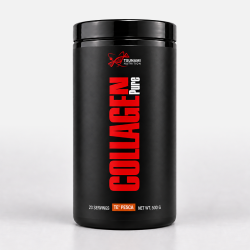
The key to effective treatment is: consistency and tailoring your supplementation to suit your own routine. Using formulations made with the highest-quality ingredients, such as those from Tsunami Nutrition, helps you achieve effective results without overloading the body.
How long is it advisable to take collagen?
It is recommended to take collagen for at least 12 weeks; benefits remain effective for up to 6 months, particularly in supporting skin firmness and reducing joint pain. Continuous intake is essential from the age of 25, when the body’s demand for collagen begins to outstrip its production, eventually depleting its reserves in adulthood.
Every six months or so, it is a good idea to take a break from supplementation to check whether the benefits are sustained over time, to assess whether it is necessary to continue, and to prevent the body from becoming accustomed to the nutrients. No advice is mandatory; however, the advice and supervision of a trusted doctor or nutritionist are necessary to assess the body’s response.
At what age should you start taking supplements?
Collagen production begins to decline from the age of 24, reaching its lowest level at the age of 35. Deciding when to start taking collagen supplements depends mainly on personal needs and the results you wish to achieve:
|
25–35 years Prevention — signs of ageing, support for bones and joints |
Around 40 Improvement — skin, hair, nails, joint mobility |
40+ Protection — loss of skin density, joint stress |
However, there is no specific age at which to start taking supplements: understanding your own body and wanting to make changes is the first step towards embarking on a healthy and effective long-term supplementation programme!
Combined use with hyaluronic acid and vitamin C
Collagen is often used in combination with hyaluronic acid for its moisturising effect. After providing structure with collagen, hyaluronic acid moisturises the tissues and offers benefits distinct from those of collagen.
Together, these two ingredients give the skin a smoother, plumper appearance. Furthermore, vitamin C further enhances the benefits of supplementation through its stimulating effect on collagen synthesis.
|
C Collagen Tissue structure and support |
AH Hyaluronic Acid Deep tissue hydration |
Vitamin C Vitamin C Stimulates collagen synthesis |
To maximise the benefits of collagen, it is a good idea to take these substances together, whilst always adhering to the recommended doses and taking them regularly to ensure long-lasting benefits.
|
03
|
Effects, safety and common misconceptions |
Collagen is a structural protein that has been in high demand in recent years for its aesthetic benefits, but also because of certain misconceptions.
|
Joints Support and comfort |
Hair & Nails Shine and strength |
Skin Elasticity and youthfulness |
There’s a common misconception that collagen makes you put on weight. But in reality,it is a protein which, like all others, not only does not cause weight gain, but if taken daily can help with body recomposition and support a diet thanks to its ability to signal satiety to the brain; its role is structural and supportive, not to increase body mass.
Collagen is very low in calories, especially when the calories from supplementation are compared to those from your total daily intake. Furthermore, it is not necessarily the case that it becomes useless after a certain age; on the contrary, it can help prevent certain side effects of ageing.
How long does it take to see the first results?
The initial benefits may not be immediate; you need to take the supplement consistentlyfor at least 4 to 8 weeks to feel improved joint health and muscle comfort. You will certainly notice improved skin hydration and firmness, as well as stronger nails and hair.
Does collagen make you put on weight: fact or myth?
|
Verdict |
|
|
The myth “Collagen makes you put on weight and becomes useless as you get older.” |
The facts It does not cause weight gain. It is a protein, sugar-free and low in calories. It helps you feel full. |
To avoid gaining weight when taking supplements, it is essential to check the ingredients added to the collagen formula.
Is taking collagen bad for your health?
Collagen is generally well tolerated by the body: as it is a protein naturally present in our bodies, it is easily digested if taken in the recommended doses.
Contraindications
| 01 Allergies to animal proteins |
| 02 Untreated kidney or liver conditions |
| 03 Gastrointestinal disturbances when taking non-hydrolysed collagen on an empty stomach |
| 04 Autoimmune conditions (medical assessment required) |
|
04
|
Frequently asked questions |
QShouldI take collagen on an empty stomach?
Yes, you can take collagen on an empty stomach, provided you do not suffer from digestive problems or gut sensitivity. Taking it this way also promotes the absorption of the peptides and helps to reduce feelings of hunger between meals.
QCan Itake collagen and hyaluronic acid together?
Yes, collagen and hyaluronic acid work synergistically to improve the health of the skin and connective tissues.
QIs itnecessary to take breaks during the cycles?
Yes, it is necessary to take periodic breaks to assess the body’s response and maintain the effectiveness of the supplementation.
QArethere any foods to avoid when taking collagen?
Foods to avoid include alcohol, sugary drinks, and processed or fried foods.
It is importantto alwayscombine supplementation with a balanced diet rich in protein, fruit, vegetables and vitamin C, which aids collagen synthesis.
Collagen is essential for maintaining the health of the skin, joints and connective tissues. Furthermore, it is vital to choose top-quality supplements, such as those from Tsunami Nutrition, to avoid slowing down the metabolism and to ensure long-lasting benefits.
Tsunami Nutrition
Start your collagen programme
Patented hydrolysed formulas — Free delivery on orders of 59 EUR or more
Discover the product