- Nutrition
- 35993 views

Given the large number of factors to consider when drawing up a nutrition plan designed to support CrossFit training, it can be difficult to know where to start and what the priorities are. Ranked from the most impactful (on body composition and performance) to the least impactful, here are five key factors to consider. We’ll examine each factor and look at how to manage it to maximise CrossFit performance and achieve the desired results.
Calories
Determining the number of calories you need to fuel your training sessions is the most important factor to consider when it comes to improving your CrossFit performance. Many people do not know how much they should eat and often eat too little, too much, or in an unbalanced way.
Eating too few calories not only affects your performance in the gym, but also has a negative impact on other aspects of your life, such as concentration, mood, motivation, circadian hormonal rhythms and sleep.
How do you work out your calorie requirements?
To work out the number of calories you need to maintain your body weight (i.e. without gaining or losing weight), you should multiply your weight in kg by 30. This roughly corresponds to the calorie requirements for a day of moderate training (1 to 2 hours, 10 to 25 sets of exercises). On rest days, simply subtract 300 calories from this figure. If there are days with two training sessions (one moderate and one intense), 300 calories should be added to the estimated requirement. For example, a woman weighing 63 kg will need around 1,800 kcal as her reference calorie intake, to be adjusted according to her activity levels on different days.
To maintain a stable weight, she should therefore eat as follows:
- Rest day: 1,800 calories
- Moderate training day: 2,100 calories
- Intense training day: 2,400 calories
Please note that these figures are intended for people who wish to maintain their body weight.
To lose weight
500 calories per day should be subtracted from this estimated requirement. So, for our 63 kg female subject, this would give the following results
- Rest day: 1,300 calories
- Moderate training day: 1,600 calories
- Intense training day: 1,900 calories
To gain weight
It is necessary to increase calorie intake by at least 500 compared to the calculated requirements, especially if the aim is to build significant muscle mass. Thus, for our example subject, the requirements will be as follows.
- Rest day: 2,300 calories
- Moderate training day: 2,600 calories
- Intense training day: 3,000 calories
It is important to remember that all these calculations are purely approximate and do not represent absolute values; they must always be carefully tailored to the individual, taking into account many other factors, such as gender, age, daily NEAT level, sporting history and body composition.
However, these are good guidelines to follow, and by applying them, you can track your progress by weighing yourself every week for three weeks. In maintenance mode, you should not lose or gain more than 1.25 per cent of your starting weight. In this case, your calorie intake should be reduced or increased accordingly.
Macronutrients
Now that you have a rough idea of how many calories to consume based on your goals, let’s look at how to break down those calories and macronutrients. Let’s start by discussing the most important macronutrient for CrossFit training: protein.
Protein
We now know that without an adequate protein intake, the body is unable to repair and rebuild stronger muscles, or to support various other biological functions regulated by protein. A good recommended protein intake for CrossFit athletes (and anyone doing strength and power training) is 1 to 2 g per kilogram of body weight. This range is very broad because, here too, the ideal protein intake must be determined not only by taking body weight into account, but also by numerous other factors such as gender, age, activity level, daily NEAT, etc. This protein intake should be kept more or less constant, both on training days and rest days.
Carbohydrates
Carbohydrates are the main fuel source for most cells in the human body. Certain tissues, known as ‘glucose-dependent’, can only function using glucose, and therefore carbohydrates. In a sport such as CrossFit, the focus is mainly on repeated bursts of power, which cause a massive build-up of lactic acid in the muscles. These efforts are almost entirely glycolytic and utilise large quantities of glucose. A low-carbohydrate diet is therefore strongly discouraged in CrossFit, especially if the focus is on performance. Without carbohydrates, the muscles are not adequately fuelled and training and/or competitions are not possible. Even the amount of carbohydrates consumed needs to be adjusted according to a variety of factors, but a good rule of thumb would be to consume:
- on rest days: 2 g of carbohydrates per kilo of body weight
- on days of moderate training: 3 g of carbohydrates per kilo of body weight
- On days of intense training: 4 g of carbohydrates per kilogram of body weight.
In light of these guidelines, it is clear that a diet tailored to CrossFit must certainly contain a significant proportion of carbohydrates, which are necessary to support the type of exercise involved. Any low-carbohydrate or even zero-carbohydrate diet is doomed to failure in a sport like CrossFit, especially in the long term.
Fats
Fats play a very important structural and functional role in our health and sporting performance. The minimum amount of fat to be consumed daily to maintain good health should be at least 0.3–0.6 g per kilogram of body weight. Once daily health requirements are met, CrossFit athletes gain no additional benefit from consuming more fat to enhance their performance. Indeed, as we have said, it is primarily a glycolytic sport, in which fats are used only to a very limited extent during exercise.
A large proportion of fat consumption occurs after training due to EPOC (Excess Post-Exercise Oxygen Consumption), but in this case, it would be beneficial for the body to draw on its own fat reserves. However, for people who consume a large number of calories per day, using larger amounts of fat can help them easily reach their calorie target, as one gram of fat can provide almost twice as much energy as one gram of protein or carbohydrates. It is worth remembering that
- one gram of protein provides around 4 kcal
- one gram of carbohydrates provides approximately 4 kcal
- one gram of fat provides approximately 9 kcal
At this stage, you need to work backwards to calculate the grams of fat to be consumed daily.
First, work out your daily calorie intake, then the recommended amounts of protein and carbohydrates; next, divide the remaining calories by 9 to work out the number of grams of fat to consume. In summary, your calorie intake is the first thing to calculate correctly, followed by your protein, carbohydrate and fat intake.
Timing of nutrient intake
Knowing how to manage your food intake throughout the day is another very common issue. Most of us know that we need to eat before and after a training session, but how much before or after? What should we eat? Does it really make a difference? Let’s start from the premise that the foundation must always be what we’ve discussed so far: a calculated calorie intake that’s correctly distributed across the different macronutrients. It is only once we have established this foundation that we can say the timing of our intake can also make a difference; otherwise, very little changes.
Pre-workout
This topic remains one of the most misunderstood. Physiologically, our bodies possess all the necessary characteristics to cope with an intense workout carried out in a fasted state – that is, a condition in which the entire gastrointestinal system is not engaged in digestive activity.
Under these conditions, all the blood can flow to the muscles involved in the activity, and the dominant nervous system will be the sympathetic nervous system, that is, the ‘fight-or-flight’ system, which enables us to maintain a state of optimal concentration and adequately activates the neuroendocrine and metabolic balances necessary for performing demanding physical exertion. Eating close to a training session creates a digestive burden, which draws blood to the intestines and triggers a conflict between digestive activity and muscular activity.
Furthermore, eating and the digestive process activate the parasympathetic nervous system, which is responsible for ‘rest and digestion’, making us less responsive and less efficient. It is therefore very important that the pre-workout meal is eaten at least 3 to 4 hours before the training session. The meal should be of moderate size and contain a good portion of complex carbohydrates, a moderate amount of protein, little fat and some fibre, to allow for rapid digestion (fat, fibre and protein slow down digestion).
If you do not have enough time between your meal and your workout – for example, if you train in the morning – you should skip the meal and eat straight after your workout. In this case, a period of adaptation will be necessary to allow the body to get used to training on an empty stomach for several hours.

However, before a performance-focused workout, it may be beneficial to take a comprehensive pre-workout supplement containing performance-enhancing ingredients. Tsunami Pure Professional is a good example. It is expertly formulated to deliver excellent performance. Its pleasant taste and high digestibility make it perfect as a pre-workout for CrossFit enthusiasts, and it can also be used as an ‘appetite suppressant’ for those who feel a little peckish before their workout begins.
Intra-workout
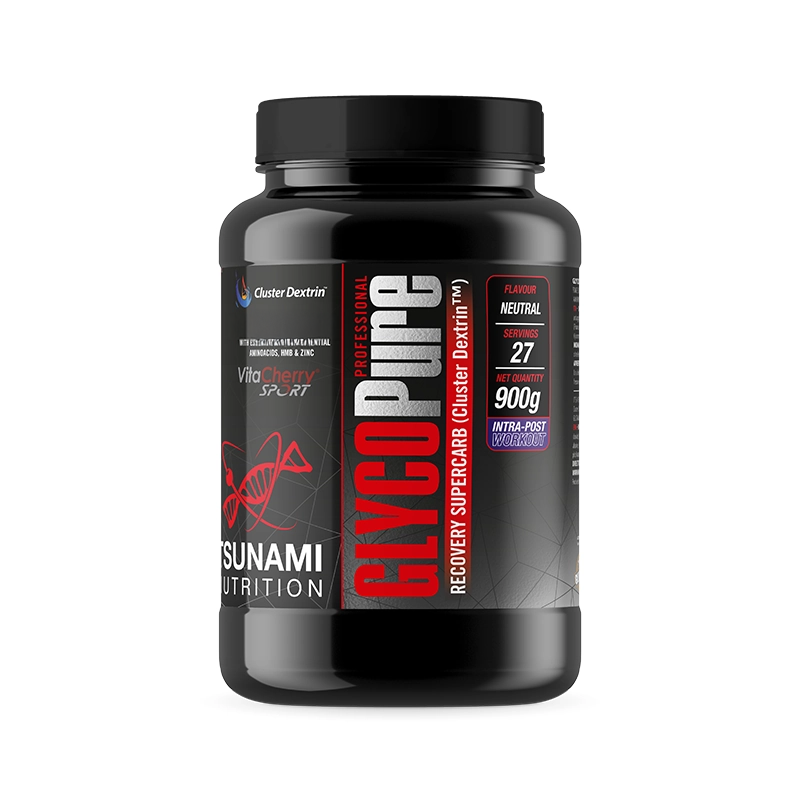
If the workout lasts a very long time – generally more than an hour – it is recommended to consume fast-absorbing carbohydrates, preferably combined with essential amino acids and, where appropriate, minerals. A good example in this case is ‘cyclodextrins’, carbohydrates with the ideal characteristics for consumption during a workout. In this case, you can use supplements specially formulated for in-training use, such as GLYCOPure PROFESSIONAL, which is uniquely formulated with cyclodextrins and amino acids, or MIG-24, the latest-generation intra-workout supplement developed by the research and development team.
Post-workout
This is the most important phase, during which all the recovery processes and adaptations associated with ‘supercompensation’ take place. At this point, the muscles are highly receptive to carbohydrates, due to the improved insulin sensitivity resulting from the workout. This metabolic state lasts for at least 3 to 6 hours after training, and it’s worth knowing how to make the most of it! This is the time to consume fast-absorbing carbohydrates and proteins, such as cyclodextrins or fruit combined with whey protein (preferably hydrolysed, as these are metabolised most rapidly).
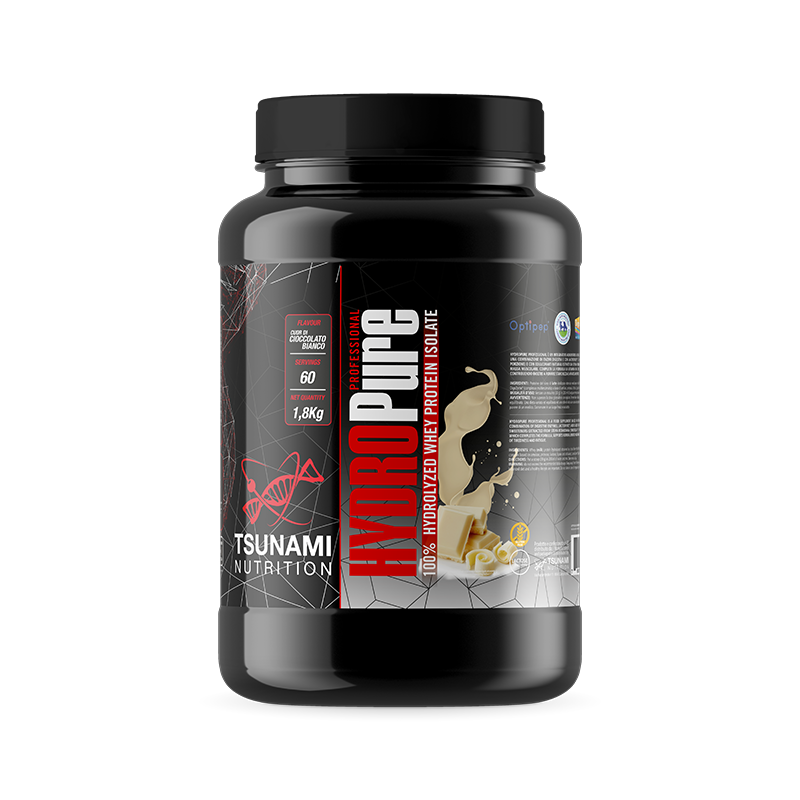
Thanks to its unique characteristics,Hydro Pure Professional is a product that lends itself very well to this. The combination of rapidly absorbed carbohydrates and proteins at this time effectively triggers muscle protein synthesis and, consequently, muscle recovery. Fats and fibre should be kept to a minimum at this stage, as they slow down the digestion of carbohydrates and proteins and therefore prevent the marked insulin response that is desirable at this stage (as insulin is a highly anabolic hormone).
In any case, these calories and macronutrients must be factored into your daily requirements.
Daily meal planning and dietary quality
It is advisable to eat 2 to 3 balanced meals containing protein, carbohydrates and fats to meet the requirements set out above. It is important to choose high-quality foods, as this also makes a difference. It is important to choose natural, unrefined, unprocessed foods, free from added preservatives, colourings, artificial flavourings and any other deceptive practices of the food industry. Respecting the seasonality and origin of produce is another important aspect to bear in mind, as is a preference for organic and biodynamic produce, pasture-reared meat and freshwater fish.
Finally, we must not forget all the micronutrients contained in natural foods. These include vitamins, minerals and many other substances found exclusively in natural foods. So, even when calorie and macronutrient content is the same, it is a good idea to choose natural foods as they will certainly provide far more micronutrients.
Very often, we pay attention only to macronutrients, forgetting that nutrition is much more than that: it is not just about macronutrients, but about a whole range of ‘responses’ and ‘reactions’ that each individual food is capable of triggering in our bodies. For example: we could eat an apple, which contains around 70 kcal, or consume the equivalent in jelly sweets.
Whilst consuming the same calories and macronutrients, the apple would provide us with vitamins, minerals, antioxidants, fibre, etc., which we wouldn’t get from the sweets! In conclusion, let’s recap the most important aspects to consider when putting together an ideal CrossFit diet:
- Calorie management
- Macronutrient management
- Daily meal planning
- Management of meals before, during and after training
- Managing the quality of the food consumed
Have we forgotten anything?
Yes, dietary supplements.
They are often seen as the last thing to add to one’s diet, after the elements listed above. However, when used wisely in conjunction with a good diet, they too can make a difference. We’ll simply mention a few of the most commonly used supplements in the world of CrossFit, leaving this complex topic for a future article devoted entirely to it:
- Caffeine
- Protein powders (whey, casein and other forms)
- Creatine
- Carbohydrates
- Multivitamins and minerals
- Omega-3
- Beta-alanine
We’ll be covering all these elements and other important supplements in detail in a forthcoming article. To ensure you have a good diet to support your CrossFit training and competitions, you need to take into account each of the categories listed above, in order from the most impactful (calories) to the least impactful (supplements).
All of this must be complemented by high-quality food, in the right quantities and at the right time of day. Only in this way, with consistency and perseverance, can you achieve a significant improvement in your general health and performance.