- Training
- 35268 views

There is no doubt that the nutritional requirements of athletes to support their physical activity are well above average. Depending on the athlete’s characteristics (weight, gender, specific demands of their sport, etc.), energy intake can be up to three to five times higher than that recommended for the average person.
In recent years, the comprehensive care provided to athletes to improve their performance has been the subject of extensive research aimed at understanding ‘what’, ‘when’ and ‘how much’ to eat, and which dietary supplements to take to maximise physical performance. However, as with most things, individual circumstances and the goals set will determine the best strategy for achieving the desired result. Consequently, each athlete requires a different approach to managing macro- and micronutrients, with particular attention paid to hydration, which is often overlooked.
The role of water in our bodies
We are composed mainly of water – around 60 to 65 per cent – an essential element not only for health but also for physical and mental performance. Many people think that simply drinking more is enough to ensure everything runs smoothly, but this is not entirely true. The real issue is that the human body’s hydration levels are constantly ‘put to the test ’ by water loss due to various mechanisms such as breathing, sweating, stress, hormones and physical exercise, to name but a few.
Another problem is that the urge to drink does not usually arise until water loss reaches 1 per cent of body weight, except in certain clinical cases. Consequently, it is highly likely that some athletes train and compete whilst unknowingly in a state of dehydration. These levels of dehydration will compromise both training sessions and cognitive performance, whilst increasing the physiological effort (i.e. heart rate and core body temperature) associated with a given exercise intensity.
Before discussing hydration strategies aimed at improving performance, it is important to take into account—and not overlook—various environmental factors. To name but a few, these include stress, variations in ambient temperature, humidity, hormonal fluctuations, the season, the athlete’s subjective state, social occasions and various endogenous symptoms or problems such as gastrointestinal disorders. These factors must not be overlooked in any proper programme, but should always be regarded as potential ‘influencing’ factors in order to prevent any problems associated with dehydration.
Without disregarding the importance of hydration throughout the day – which, as we have said, must be tailored to the individual and their lifestyle – let’s briefly look at some guidelines and possible additional considerations regarding intra-workout hydration, that is, the period from the start to the end of your training session.
In light of this issue, we’ll take a look at the importance of hydration in sport.
Why is hydration important in sport?
When we talk about the ‘optimal diet for athletes’, focusing on foods and macronutrients, we often overlook a crucial factor: hydration. Indeed, it has been confirmed time and again that, to optimise athletes’ performance during training and competition, it is essential for the body to remain well-hydrated! When it comes to competitive sports – particularly mixed sports such as football, combat sports and CrossFit, as well as anaerobic sports like bodybuilding and aerobic sports such as endurance sports – the issue of hydration can still raise many doubts and pose a real challenge for professionals.
For example, amongst MMA athletes or even in bodybuilding competitions, perhaps based on hearsay or due to an old-school coach, protocols are still being recommended that manipulate bodily fluids to an extreme degree. Unfortunately, if not properly planned, this inexplicable practice can have disastrous consequences for the athlete, compromising not only their health but also their performance. If we analyse it, water is, after oxygen, the second most essential element for our survival. Although the body can withstand a loss of 40 per cent of its body weight due to starvation, a loss of just 9 to 12 per cent of its body weight due to fluid loss can be fatal.
Pre-workout hydration strategies
Proper hydration before exercise is essential for tackling any serious training session or competition.
- Before exercise, athletes must be well hydrated and have full muscle glycogen stores.
- Chronic dehydration can occur in athletes who undertake repeated training sessions (even several times a day) or several matches (tournaments) on the same day or over several consecutive days. It is important to bear in mind that athletes will often need help in recognising this problem.
- Electrolytes will help the athlete restore and maintain electrolyte balance following dehydration caused by physical exercise and sweating. Thus, starting training with them can trigger various important processes to prevent the athlete from becoming completely exhausted.
- Athletes should drink at least 500 ml of fluid 2 to 3 hours before exercise, which gives them plenty of time to pass any excess fluid, and then consume further litres before and during the event.
- Changes in body weight, urine colour and urine density are all valid indicators of hydration status. Athletes, coaches and nutritionists should regularly use these methods to assess hydration status before exercise.
The solution from TSUNAMI NUTRITION
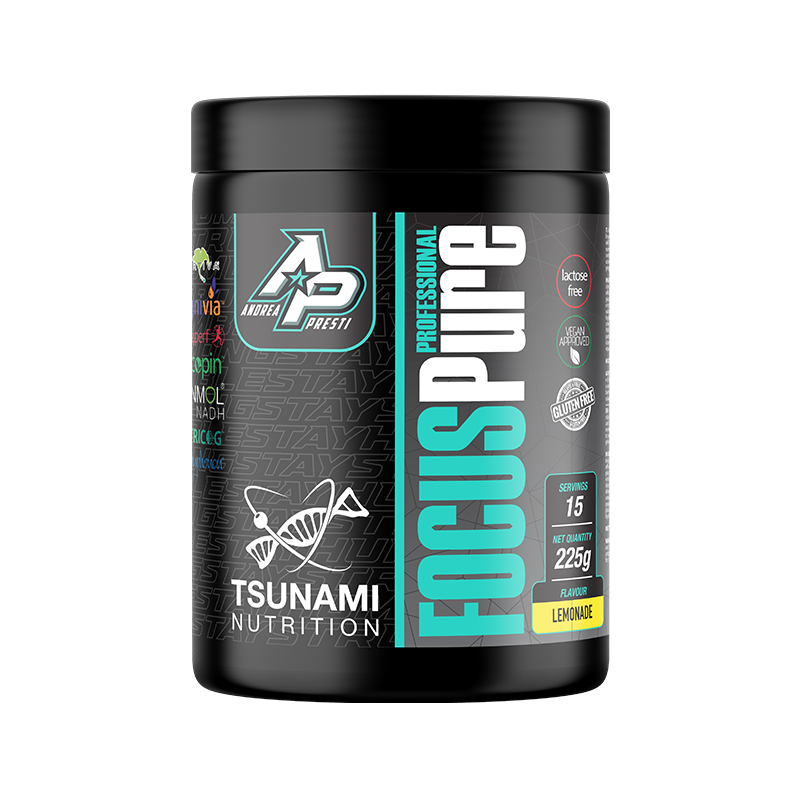
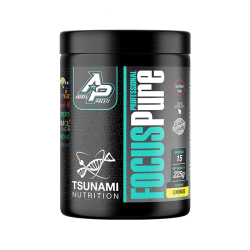
Given the importance of hydration even before the event, we can in this case optimise fluid intake (200/300 ml) by adding an innovative, caffeine-free pre-workout product which, as well as providing vitamins and minerals essential for performance, contains nutraceutical ‘activators’ to better prepare the body for the upcoming exertion.
Introducing Focus Pure Professional, a caffeine-free and creatine-free pre-workout supplement (to avoid issues with dependency, water retention or a ‘crash’) with a formula based on nutraceuticals, phytotherapeutic agents and innovative active ingredients, designed to optimise concentration and elevate performance to unprecedented levels.
Overall, Focus Pure will prepare you as effectively as possible for your event, improving not only your cognitive focus but also your hydration levels. Its innovative formulation contains various essential co-factors such as minerals, vitamins, amino acids, procyanidins and certain unique patented ingredients such as Beet’4Perf™, specially included to provide all-round support for athletes throughout their competition or training session.
Hydration strategies during exercise
Although this is not widely known, proper hydration during physical exercise offers numerous benefits. It reduces cardiovascular strain, optimises heat dissipation, and helps maintain plasma volume and cardiac output at optimal levels – all of which are important factors in maximising exercise capacity and intensity. It is therefore recommended that the following hydration strategies be carefully considered during the event (training, competition, match, etc.).
Where possible, fluids should always be available, and athletes should regularly consume a hydrosaline drink without ‘overhydrating’. Of course, this may prove difficult to achieve during certain events that do not include frequent breaks.
Athletes should aim to optimise their fluid intake without overhydrating. They need to assess their rate of sweating in order to adjust their intake during training. This can be difficult to measure, but by being monitored by specialist staff, athletes can be supported on their journey towards their goal. One piece of advice we give to athletes is to learn to listen to their bodies, consume the right amount of fluids and assess their body composition.
Few people realise this, but to optimise gastric emptying, you should always have between 200 and 500 ml of fluid in your stomach. If the fluid contains dissolved carbohydrates (assessing the correct ratio and type of carbohydrates during competitions is a great advantage), the carbohydrate concentration should be between 4 and 8 per cent. Although their function is to provide energy, not all carbohydrates are the same (we’ll explore this topic in more detail in another article), so it’s important to carefully consider the type of carbohydrates to use.
The solution from TN NATURALS
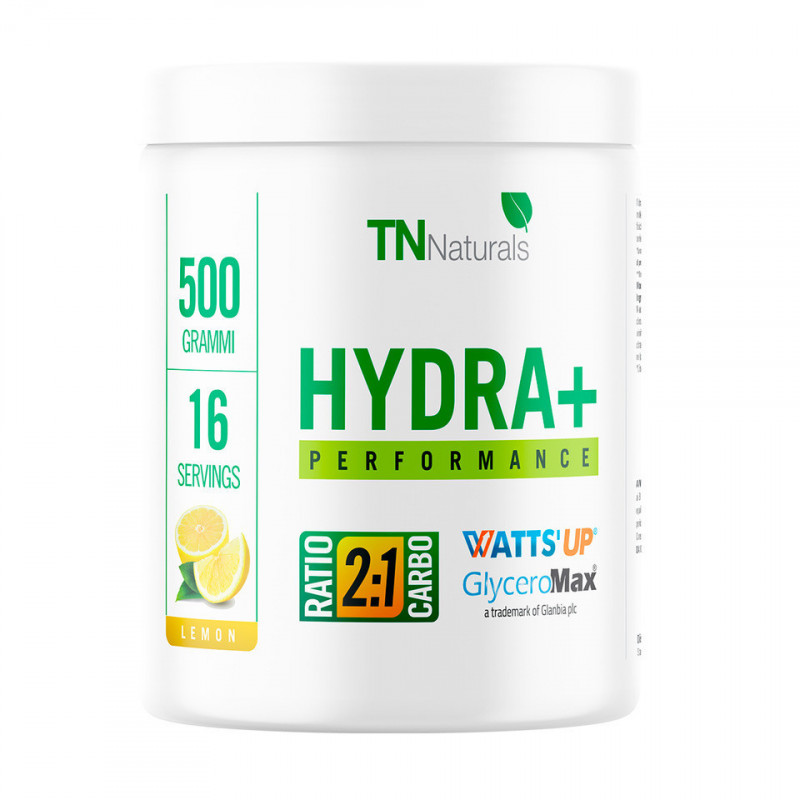
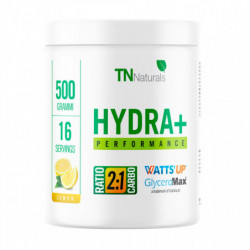
After using a good pre-workout supplement to support the body during physical activity, we can turn to Hydra+ Performance by TN Naturals, an exclusive formulation comprising a blend of carbohydrates and minerals designed to enhance energy performance. In addition to electrolytes such as potassium and magnesium, which are essential for optimal hydration, an exclusive blend of simple carbohydrates and high-molecular-weight molecules such as HBCD cyclodextrins has been added, capable of ensuring support for psychophysical performance during exercise.
In certain situations, such as intense and, above all, prolonged training sessions, or during low-calorie diets and extreme training regimens, compounded by travel and seasonal changes that lead to significant fluid loss, supporting our bodies during training sessions or events can prove to be a key factor in staying in peak condition.
Furthermore, taking an intra-workout supplement such as Hydra+ Performance can help stabilise blood glucose levels, replenish lost muscle glycogen and maintain proper hydration – all of which are essential for athletes. Finally, to complement our Hydra+ Performance, we have added a range of patented compounds with remarkable properties, such as GlyceroMax® and Hesperidine WATTS’UP®, which are essential for improving performance and optimising hydration.
Post-workout hydration strategies
Finally, let’s look at the period following exercise – the post-workout phase – which offers the opportunity to recover fully and replenish nutrients, including fluids and their electrolytes, which have been depleted during training or competition. A rehydration strategy following intense exercise is essential and must be considered separately from hydration before and during exercise. If the athlete has been properly hydrated since the start of the exercise, it can be assumed that the reduction in body weight reflects the loss of body water during the event. Furthermore, the importance of adequate rest after an intense training session should not be underestimated. Although I have already covered this topic in other articles, I would like to reiterate that our bodies recover best when they have everything they need, including adequate replenishment of fluids, macronutrients and micronutrients, dietary supplements and restorative sleep.
Here are a few tips on this subject:
- Body water can be replenished after exercise by drinking fluids with or without carbohydrates and electrolytes, taking into account the intensity of the workout and ‘what’ was consumed before and during training. However, water alone may not be the best rehydration drink at this stage, as it lowers osmolality (a measure of solute concentration), reduces the urge to drink and may increase urine output. The much-feared ‘salt’ (sodium or sodium chloride) will actually help retain fluid volume more effectively and increase the urge to drink if added to a rehydration drink or food (a handy tip to remember). For athletes who need to rehydrate between training sessions without consuming solid meals, choosing a rehydration drink containing electrolytes is a very important consideration. Indeed, it is recommended to prepare a proper liquid meal, tailored to the individual, made from ingredients that are rapidly absorbed by the stomach (fast-acting carbohydrates, amino acids, hydrolysed proteins, etc.) to cater for any eventuality and, above all, one that is compatible with your gastrointestinal system.
- Given that glycogen stores are generally depleted after an intense training session, it is important – depending on the phase and individual tolerance – that rehydration also includes an adequate intake of carbohydrates. In addition to the benefits already mentioned in previous articles, carbohydrates can also improve the intestinal absorption of sodium and water, thereby promoting recovery.
The solution from TSUNAMI NUTRITION
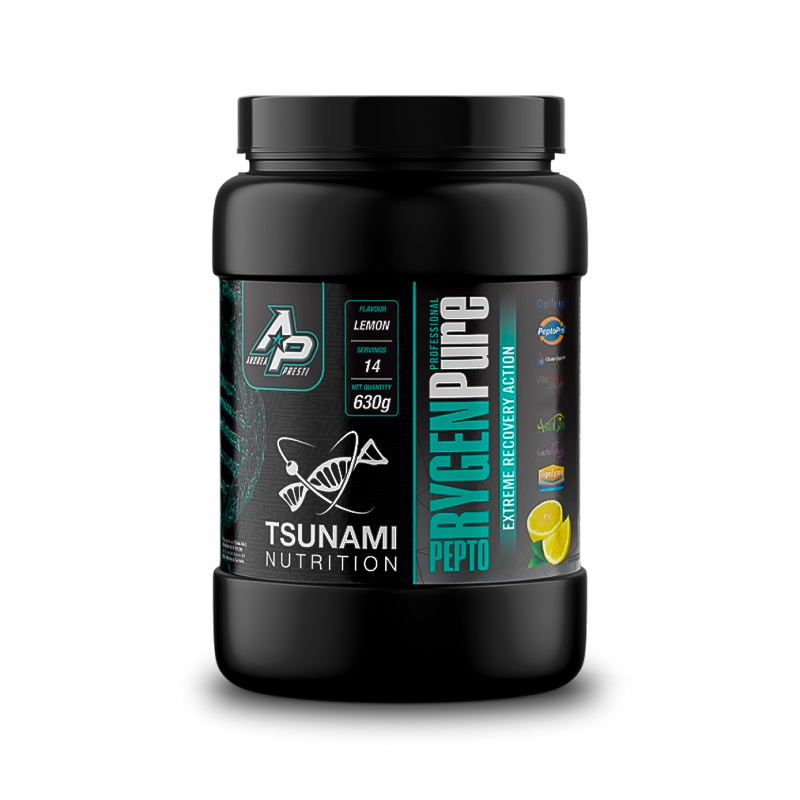
For post-workout recovery, we offer a truly comprehensive all-in-one product, designed not only to improve hydration but also to support the whole body, which has been put under considerable strain during the previous training session.
Introducing PEPTORYGEN Pure Professional, a combination of the finest ingredients available on the market, designed primarily for post-workout nutrition – that is, the period beginning at the end of your workout. PEPTORYGEN Pure Professional is undoubtedly one of the most innovative post-workout supplements ever created, with a comprehensive formulation featuring high-quality, exclusive patented ingredients such as Optipep, PeptoPro, Cluster Dextrin, VitaCherry Sport, Ajinomoto, AstraGin, LactoSpore and DigeZyme.
Overall, PEPTORYGEN Pure Professional provides the right balance of carbohydrates, proteins, vitamins, minerals and nutraceuticals to promote recovery and enhance performance for the next session. A top-of-the-range, one-of-a-kind product, gluten-free (like all our products) and with a lactose content of less than 0.2 g, which, as part of a well-structured programme, will fully meet the metabolic needs of athletes – whether professional or amateur – for unrivalled, complete recovery.
Remember, for any car worth its salt, it’s not enough just to give it the right fuel; you also need to implement all the strategies that, in the long term, will make it unique and unbeatable.