- Training
- 35064 views

Protein powders: what are they and what are they used for?
Protein powders are one of the most widely used sports nutrition supplements in the world, and for good reason. They offer a wide range of benefits, as demonstrated by dozens and dozens of scientific studies. For example, consuming protein helps to increase muscle mass and aid weight loss, improves performance and reduces fatigue during exercise, aids recovery after intense exercise, and reduces the risk of cardiovascular and metabolic diseases.
Proteins are made up of amino acids, which are essential for life. Of these, 8 (or 9, depending on age) are known as essential amino acids because the body cannot produce them and they must therefore be obtained through diet. Amino acids can be described as the building blocks of proteins: if they are incomplete or of poor quality, problems may arise.
Consuming protein that lacks a full spectrum of amino acids reduces its effectiveness and therefore its benefits. Furthermore, poor-quality protein is more difficult to absorb and assimilate, which further reduces its benefits.
Benefits of protein powders
Protein is found in all animal-based foods such as meat, fish, eggs and cheese, but also in many plant-based foods, such as soya, peas, hemp and lentils. So, whether you are an omnivore or a vegan, with a little care, it is possible to obtain all the essential amino acids from your diet without suffering from any deficiencies.
However, there are times when people prefer protein powders because, compared to food, they offer several advantages:
- They’re very convenient when you’re short on time
- They’re very easy to digest and don’t leave you feeling heavy
- They’re excellent for meeting your daily protein targets without having to stuff yourself with food every day (which is often unappetising)
- They can be very affordable in terms of price per gramme of protein, allowing you to eat healthily on a limited budget
- They are low in fat and carbohydrates, which isn’t always the case with solid foods
- They’re extremely versatile in the kitchen and can be incorporated into many recipes (for example, pancakes, cakes, burgers, etc.).
How many types of protein powder are there?
There are many types of protein powder on the market. Before looking at some of them in detail, let’s see how they are categorised:
- Primary source: animal or plant
- Secondary source: which animal species (e.g. milk, meat or eggs) and/or plant species (e.g. soya, peas or hemp)
- Quality: the degree of purity of the protein, which guarantees a certain amount of protein per gramme of powder
- Rate of absorption: the speed at which the proteins are absorbed by the body. There are fast-absorbing products, such as Isolate Pure Professional, and slow-release products, such as 4Source Pure PROFESSIONAL.
Different people may find one type suits them better than another. Sportspeople, and particularly athletes, should prioritise consuming proteins of a very high degree of purity, as the purer the substance, the higher the actual quantity of protein in the product.
Protein isolates
Protein isolates are produced using a more sophisticated and innovative process than that used for standard proteins. This guarantees a very high degree of purity, which not only results in better absorption but also removes ‘unnecessary’ components such as fats, minerals and lactose.
Those seeking maximum purity to get the most out of the benefits should undoubtedly opt for this type of protein.
In the case ofISOPure PROFESSIONAL, purity is guaranteed by the innovative cross-flow ultra-microfiltration (CFM®) process, which has led to the award of Isolac® (CARBERY®) certification. All quality analyses and certificates can be viewed on the website.
Hydrolysed proteins
However, it is sometimes necessary to use a different type of protein, one that is distinguished not only by its source or purity. People suffering from digestive problems or athletes who require very rapid absorption need a protein that is pure, high-quality, but above all easy to digest: hydrolysed protein.
Hydrolysed proteins have been developed to ensure unrivalled digestibility. This is made possible by an advanced microfiltration process that allows for absorption that is almost 40 per cent faster than that of isolates.
As well as after training, it is also recommended to consume them 30 to 60 minutes before exercise. Indeed, their almost instantaneous absorption allows all the essential amino acids to enter the bloodstream, ensuring a strong anabolic boost or, in the event of calorie restriction, preserving lean body mass thanks to branched-chain amino acids (BCAAs).
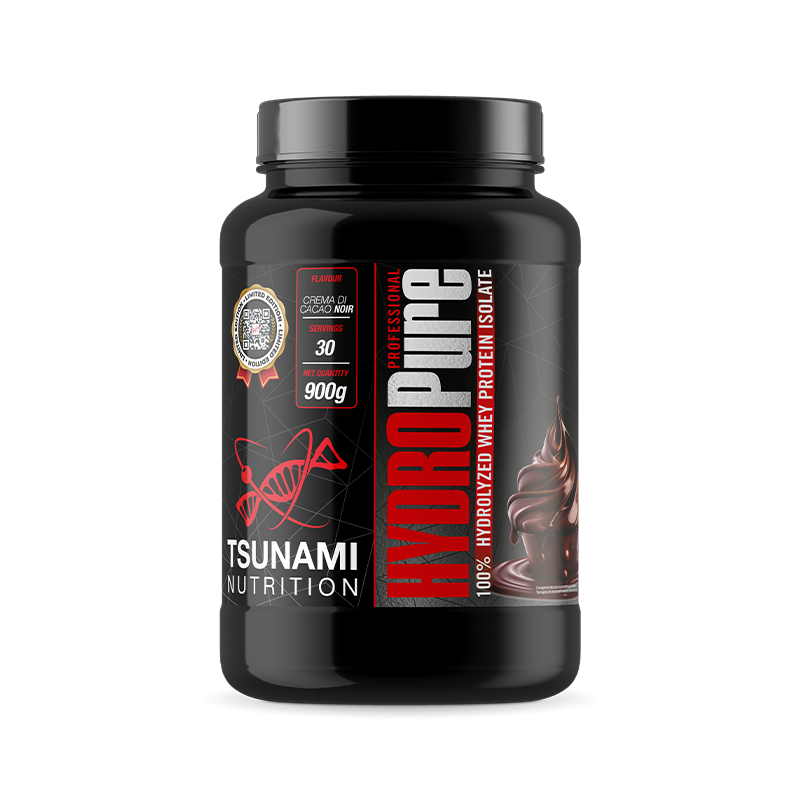
HYDROPure PROFESSIONAL by Tsunami Nutrition, as well as being manufactured using the innovative cross-flow ultra-microfiltration (CFM®) system, contains both DigeZyme® and Lactospore®, thus guaranteeing unrivalled absorption in the protein powder sector.
In addition to these significant benefits, hydrolysates also have the distinct advantage of dissolving much more readily in water than conventional whey proteins. This may seem trivial, but as well as significantly improving the taste and flavour, it also aids absorption, as the proteins arrive in the stomach already dissolved, which further increases the rate of absorption.
The protein digestion process
But in what way are the digestion and absorption of hydrolysed proteins faster than those of conventional proteins?
Traditional proteins are complex protein molecules that require several stages of digestion and absorption, facilitated by specific enzymes in the stomach, pancreas and small intestine. They are first broken down into smaller fragments which enter the small intestine, where they are further broken down into smaller peptides and absorbed.
Hydrolysed proteins mainly contain dipeptides and tripeptides, which are easily absorbed, thus bypassing the initial stages of digestion. This is why they are described as ‘pre-digested’.
Advantages over conventional proteins
Hydrolysed proteins have been the subject of numerous scientific studies, and it would appear that they offer more benefits than conventional proteins. In particular, their main advantages are as follows:
- Improved availability and absorption of amino acids
- Increased insulin stimulation, leading to greater muscle growth
- Better recovery after training
- Increased protein efficacy in older people.
Conclusion
Protein powders are an extremely useful and versatile supplement. Hydrolysed proteins offer numerous advantages over conventional proteins, such as greater amino acid availability, improved recovery after training and, above all, significantly improved digestion. Products such as Hydro Pure by Tsunami Nutrition allow these benefits to be maximised thanks to the purity and quality of the raw material.