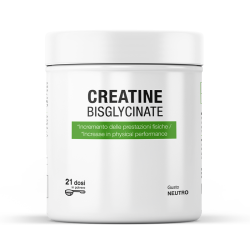
Creatine Bisglycinate 200 g
Creatine monohydrate in bisglycinate form to increase bioavailability and effectiveness. Flavors: Plain and Lemon. VEGAN. GLUTEN-FREE. LACTOSE-FREE.
€23.41
€19.90
Creatine bisglycinate is a form of creatine bound to two glycine molecules. It is used as an alternative to the classic monohydrate and can be a useful supplement for those who practice strength sports and high-intensity activities.
On Tsunami Nutrition, you can compare the different types of creatine available and choose the one that best suits your needs based on formulation, format, and dosage.
Creatine monohydrate in bisglycinate form to increase bioavailability and effectiveness. Flavors: Plain and Lemon. VEGAN. GLUTEN-FREE. LACTOSE-FREE.
Creatine bisglycinate is a form that combines creatine and glycine. It is one of the alternatives to creatine monohydrate, which remains the most studied and widely used form in sports supplementation.
Creatine is involved in the mechanisms that allow the body to rapidly produce energy during short, intense efforts. For this reason, it is mainly used in training where strength, power and the ability to repeat high-intensity sets are key factors.
Creatine is used mainly in sports characterised by short, intense and repeated efforts. It is therefore widely used in bodybuilding, powerlifting, sprints and functional training.
It can also be included in programmes aimed at increasing muscle mass, together with a suitable diet, a well-structured training programme and sufficient protein intake.
When it is difficult to reach the planned protein intake through diet alone, protein powder or specific protein formulas for muscle mass gain can be used.
The main difference concerns the form used.
When comparing them, it is especially useful to check the actual amount of creatine provided per serving, together with the product composition and format.
Creapure® creatine is creatine monohydrate produced in Germany according to specific production and purity standards. Bisglycinate, on the other hand, uses a different form of creatine.
For those looking for a simple and extensively studied option, monohydrate remains a reference. Creapure® allows you to choose a clearly identifiable raw material, while bisglycinate provides another option for those who prefer a different formulation.
The dosage should be assessed based on the actual amount of creatine contained in the product. We recommend checking the serving size indicated on the label and following the directions for use provided on the packaging.
Creatine can be included in the same routine as other supplements. It can be combined with protein or, during a phase focused on weight and muscle gain, with a mass gainer.
Creatine can be taken before or after training or at another time of day. Consistency matters more than choosing a specific time.
Those who organise their supplementation around their training session can take it together with pre-workout supplements or post-workout supplements. During longer workouts, specific intra-workout supplements may also be used.
The format can be chosen according to personal habits. Creatine powder makes it easy to manage the amount and can be added to a shake. Creatine tablets and chewable creatine are more convenient to carry, as are creatine softgels.
The format therefore mainly changes how intake is organised throughout the day.
Bisglycinate is one of the different formulations available. Before purchasing, it is useful to check the form of creatine, amount per serving, number of servings and format.
To compare the alternatives, you can start from the general category of creatine supplements, which also includes creatine monohydrate, creatine phosphate and Creapure®.
Creatine monohydrate remains the most studied form and is the main reference in sports supplementation. Bisglycinate can be considered by those who prefer a different formulation.
It can be taken before or after training or at another time of day. The most important aspect is to maintain the consistency indicated by the product directions.
If the product is intended for daily use, it can also be taken on non-training days, following the dosage indicated on the packaging.
Creatine can support performance during short, intense exercises and complement a programme aimed at increasing muscle mass. Diet, training and recovery remain part of the same process.
Yes. Creatine and protein can be used as part of the same routine. Protein helps meet daily protein requirements, while creatine is mainly used to support performance during high-intensity efforts.