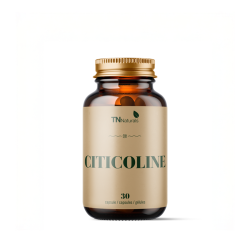
Citicoline 30 caps
Cognizin® citicoline supplement to support memory, concentration and mental performance. Vegan. Gluten free. Lactose-free.
€59.80
€29.90
Choline is an essential nutrient involved in various bodily functions. It contributes to normal lipid and homocysteine metabolism and to the maintenance of normal liver function. In addition, it plays a role in the structure of cell membranes and in the synthesis of certain molecules important for cell function.
Choline can be obtained through the diet and is naturally present in various foods, including eggs, meat, fish, legumes, and nuts. The body is able to synthesize some of it, but diet is an important source for ensuring an adequate intake of this nutrient, in addition to supplementation when dietary intake does not meet the recommended requirements.
Cognizin® citicoline supplement to support memory, concentration and mental performance. Vegan. Gluten free. Lactose-free.
Choline is an essential nutrient involved in various functions of the body. It contributes to normal lipid and homocysteine metabolism and to the maintenance of normal liver function.
Choline is a nutrient used by the body for various cellular processes related to the normal functioning of the liver.
Choline is a nutrient, while citicoline (CDP-choline) is a compound containing choline and cytidine. They are different substances, although they are metabolically related.
It is useful to check the actual amount of choline provided by the daily serving, taking into account the form used and the information provided on the label.
There is no specific time of day that is suitable for everyone. It is advisable to follow the directions provided on the product label.
Choline is an essential nutrient involved in several functions of the body, including normal lipid and homocysteine metabolism and the maintenance of normal liver function. For this reason, when using a food supplement, it is advisable to follow the directions for use provided by the manufacturer and take the product regularly as specified by the formulation.
If the supplement also contains other ingredients, it is also useful to consider the directions relating to the overall composition rather than only the amount of choline.
The amount depends on the formulation and the dose specified for the product. Always follow the directions provided on the packaging.
EFSA has established an adequate intake of 400 mg of choline per day for adults, taking into account the total intake from the diet. This value does not automatically correspond to the amount that should be taken through a food supplement.
When evaluating a product, it is important to check how much choline is provided by the recommended daily dose and also consider the amount obtained through food.
When choosing a choline supplement, it is useful to first compare the form used and the amount of choline per serving, checking the actual intake provided by the daily serving.
The overall formulation may also vary: some products may mainly provide choline, while others may combine it with additional ingredients. It is therefore important to read the complete composition provided on the label.
Choline is naturally present in a variety of foods, including eggs, meat, fish, whole grains, fruit, vegetables, fats and oils. Dietary intake represents the main source of choline for most people.
The amount of choline present in foods may vary depending on the type of food and the portion consumed. Therefore, when considering the use of a choline supplement, it is useful to also take into account the intake provided by the diet and not only the amount supplied by the product.
Choline is involved in several physiological functions. It is a component of phospholipids in cell membranes and participates in lipid metabolism and transport. It is a precursor of acetylcholine, a neurotransmitter involved in various processes of the nervous system, and of betaine, which participates in homocysteine metabolism. Choline also contributes to the maintenance of normal liver function.