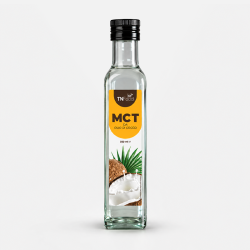
MCT from Coconut Oil 250 ml
MCT coconut oil ideal for preparing and seasoning tasty and imaginative fit recipes! VEGAN. GLUTEN-FREE. LACTOSE-FREE. KETO FRIENDLY.
€12.38
€9.90
Tsunami Nutrition's MCT Oil is an oil made from medium-chain triglycerides (MCTs), a type of fat that occurs naturally in certain food sources and is particularly associated with coconut oil. The MCTs used in these oils are generally composed of caprylic acid (C8) and capric acid (C10).
The oil can be consumed directly or used to complement various foods and dishes, depending on personal preference and the product’s instructions.
MCT coconut oil ideal for preparing and seasoning tasty and imaginative fit recipes! VEGAN. GLUTEN-FREE. LACTOSE-FREE. KETO FRIENDLY.
MCTs (medium-chain triglycerides) are a type of fat made up of medium-chain fatty acids. They occur naturally in certain food sources, particularly coconut oil.
MCTs are characterised by a medium-chain structure and mainly include fatty acids such as caprylic acid (C8) and capric acid (C10). They are also used in the formulation of oils and food supplements.
MCTs can be obtained from sources rich in medium-chain fats, particularly coconut oil and palm oil, through specific extraction and fractionation processes.
Coconut oil naturally contains MCTs, but also other types of fatty acids. MCT Oil is a formulation concentrated in medium-chain triglycerides, generally obtained through fractionation processes.
It is useful to check the actual amount of MCTs per serving and, where indicated, the presence of individual fatty acids such as C8 and C10. It is also important to consider the recommended daily dose.
Liquid MCTs can be taken directly or added to foods and beverages, following the directions for use provided on the label.
MCT Oil can be used, for example, in food preparations or beverages, according to personal preferences.
MCTs (medium-chain triglycerides) are metabolised differently from long-chain fats and are rapidly absorbed and transported to the liver, where they can be used in energy processes and contribute to the production of ketone bodies.
The amount depends on the formulation and individual tolerance. It is advisable to start with the dose indicated by the manufacturer and not exceed the recommended amount.
Scientific studies have used different amounts of MCTs and different intake methods, making it difficult to establish a single dosage applicable to every product. Some research also suggests starting with small amounts and increasing gradually, particularly to reduce the risk of gastrointestinal discomfort.
If you wish to increase the amount, it is preferable to do so gradually and pay attention to your individual tolerance.
There is no single time of day that is suitable for everyone. MCTs can be used as part of the daily diet according to the product instructions.
The timing of intake may also depend on the amount used and individual tolerance. Some research on MCTs has assessed intake on an empty stomach or together with meals, but it is not possible to identify a single method that is valid for all uses and all formulations.
In case of gastrointestinal sensitivity, it may be useful to pay particular attention to the amount taken, as MCTs can cause digestive discomfort, especially at high doses.