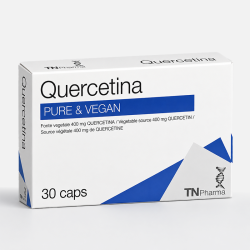
Quercetina 30 caps
Pure quercetin supplement. Anti-inflammatory and antioxidant action. Supports the immune system. Vegan. Gluten free. Lactose-free.
€9.90
€8.42
Quercetin is a natural flavonoid belonging to the polyphenol family, found primarily in foods such as onions, apples, berries, citrus fruits, broccoli, and tea. It is one of the best-known plant extracts used in dietary supplements designed to promote well-being and protect against oxidative stress. Scientific research has focused primarily on its antioxidant properties and its interaction with various mechanisms involved in the body’s response to external stressors.
Thanks to its promising nutraceutical profile, quercetin is often included in formulas designed to support general well-being and the body’s defenses. It is available both as a standalone ingredient and in combination with vitamin C, zinc, and other plant compounds. In supplements, it can also be used in formulations designed to improve its bioavailability, which is naturally rather limited. An interesting choice for those who wish to enrich their diet with a widely studied plant-based flavonoid.
Pure quercetin supplement. Anti-inflammatory and antioxidant action. Supports the immune system. Vegan. Gluten free. Lactose-free.
Quercetin is a flavonol, a particular category of polyphenols naturally produced by plants. It is found in numerous everyday foods, with particularly interesting concentrations in onions, apples, berries, broccoli, citrus fruits and tea.
Like many other polyphenols, Quercetin is studied for its ability to interact with the body's antioxidant systems and with various cellular processes involved in the response to oxidative stress.
An important characteristic of Quercetin is its relatively low bioavailability when taken orally. For this reason the nutraceutical sector has developed specific formulations and combinations aimed at improving its absorption.
Precisely thanks to its plant-based profile and the extensive scientific literature available, Quercetin has become a highly valued ingredient in supplements dedicated to daily well-being, healthy aging and nutritional support during particularly demanding periods.
Quercetin is particularly valued for its antioxidant properties and is one of the most studied polyphenols in the field of nutrition and dietary supplementation.
Research has analyzed its possible role in mechanisms linked to oxidative stress, the inflammatory response and immune function. For this reason it is often used in formulations designed for those who wish to support their well-being through plant-based ingredients.
Another area of interest concerns cardiovascular well-being and endothelial function, while in the sports sector Quercetin has been studied in relation to oxidative stress, blood flow and mitochondrial activity. The results on physical performance are however variable and do not allow it to be considered an ergogenic aid capable of automatically improving performance.
Quercetin is therefore particularly interesting as a component of a nutritional strategy aimed at general well-being, especially when it is combined with other selected micronutrients and antioxidants.
Quercetin can be taken daily while always following the recommended amount on the label of the specific supplement.
There is no universally best time of day: it can be taken at breakfast, lunch or at another convenient time in one's routine. For continuous use, regularity of intake is generally more important than choosing a precise time.
Since Quercetin naturally has limited oral bioavailability, some supplements use technologies or combinations with other ingredients to promote its absorption. The overall formulation of the product can therefore represent an important element when choosing the supplement.
Those taking medications should instead pay greater attention: Quercetin can interact with some medicines and affect enzymes involved in their metabolism. In the presence of drug therapies or particular conditions it is therefore advisable to consult one's doctor before use.
Quercetin is a plant polyphenol particularly studied for its antioxidant properties and for its interaction with various cellular mechanisms. In supplements it is often chosen as part of formulas dedicated to general well-being, healthy aging and nutritional support during periods of greater physical or environmental stress.
Quercetin is naturally present in numerous plant foods. Among the best-known sources are onions, apples, berries, citrus fruits, broccoli, tea and aromatic herbs. A supplement however makes it possible to take standardized and easily quantifiable amounts compared with the variable amounts normally present in the diet.
Quercetin and vitamin C are frequently combined in supplements. The combination makes it possible to bring together a plant flavonoid and a vitamin that contributes to the protection of cells from oxidative stress and to the normal function of the immune system. For this reason they represent a very common pairing in formulations dedicated to well-being and the body's defenses.
There is no mandatory time. Quercetin can be taken during the day following the directions provided on the supplement. Choosing a fixed time, for example during one of the main meals, can make it easier to maintain consistent intake over time.
Quercetin is generally well tolerated at the amounts commonly used in supplements, but it can interact with some medicines. Particular attention is recommended for those taking immunosuppressive drugs, blood pressure medications, some antihistamines or other therapies metabolized by specific liver enzymes. In the presence of drug therapies, pregnancy, breastfeeding or particular clinical conditions it is therefore advisable to consult a doctor before use.