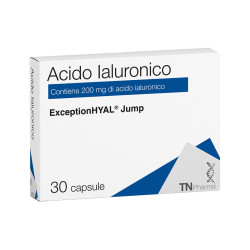
Hyaluronic Acid 200mg 30 caps
ExceptionHYAL® Jump patented hyaluronic acid for tissue and joint health. Vegan. Gluten Free. Lactose-free.
€24.90
€21.17
Hyaluronic acid is a substance naturally present in the body and particularly concentrated in the skin, connective tissues, and synovial fluid of the joints. Its best-known characteristic is its ability to bind large amounts of water, contributing to the tissues’ hydration, elasticity, and viscosity. For this reason, it is widely used in the beauty industry and in formulations designed to support joint health. In dietary supplements, it may be present on its own or combined with collagen, vitamin C, and other selected nutrients.
Oral supplementation with hyaluronic acid is currently the subject of numerous studies, particularly regarding skin hydration, skin appearance, and joint comfort. It is especially valued by those who wish to simultaneously care for their skin and joints through a targeted nutritional routine. The quality of the raw material, the molecular weight, and the dosage are important factors to consider when choosing a supplement.
ExceptionHYAL® Jump patented hyaluronic acid for tissue and joint health. Vegan. Gluten Free. Lactose-free.
Hyaluronic Acid is a glycosaminoglycan, that is a molecule composed of long chains of sugars naturally produced by the body.
It is found mainly in the skin, cartilage, connective tissue, eyes and the synovial fluid found inside the joints.
One of its most interesting properties is its ability to attract and retain water. This characteristic contributes to the viscoelastic properties of tissues and explains why Hyaluronic Acid has become one of the best-known ingredients both in the cosmetic sector and in the nutraceutical sector.
Over the years the amount and distribution of Hyaluronic Acid in tissues can change. For this reason supplements that contain it are particularly widespread in formulations dedicated to healthy aging, skin beauty and joint health.
Hyaluronic Acid taken as a supplement should not however be confused with fillers, creams or injections: these are different methods of use, with specific characteristics and purposes.
Hyaluronic Acid is particularly interesting because of its natural presence in tissues that require hydration, elasticity and the ability to withstand stress.
In the field of dietary supplementation it is studied mainly in relation to the skin. Some research on oral intake has observed interesting results on parameters such as hydration, elasticity and skin appearance, which is why it is frequently used in beauty and anti-aging formulas.
Another important area of interest concerns the joints. Hyaluronic Acid is naturally present in synovial fluid, where it contributes to the viscosity and lubrication characteristics of the joint environment. For this reason it is often included in supplements dedicated to mobility, comfort and joint health.
The combination with collagen is also particularly interesting: the two ingredients play different roles in connective tissues and are frequently combined in formulations aimed at skin, cartilage and joints.
Hyaluronic Acid supplements can be taken daily always following the directions for use and the amount indicated on the package.
There is no universally best time of day. Hyaluronic Acid can be taken in the morning, during one of the meals or in the evening, depending on the formulation and personal habits.
More than the exact time, consistency in taking it is generally important, since studies on oral supplementation normally evaluate use over periods of several weeks and not an immediate effect resulting from a single dose.
It can also be taken together with collagen and other nutrients found in formulas for skin and joints. Vitamin C, for example, contributes to normal collagen formation for the normal function of skin, cartilage and bones, making it a widely used complementary ingredient.
In the presence of particular conditions, pregnancy, breastfeeding or drug therapies it is always advisable to seek the advice of a healthcare professional before starting supplementation.
Hyaluronic Acid is naturally present in skin, connective tissue and joints and is known mainly for its ability to retain water. In supplements it is used mainly in formulations dedicated to skin beauty, healthy aging and joint health. Research on oral intake is particularly active and has mainly analyzed parameters related to skin hydration and joint comfort.
They are not alternative ingredients, because they play different roles. Collagen is one of the main structural proteins of skin, cartilage, bones and other connective tissues, while Hyaluronic Acid is particularly important for the hydration and viscosity characteristics of tissues. Precisely for this reason they are often combined in the same supplement to obtain a more complete formulation.
Yes. Hyaluronic Acid and collagen are often present in the same formulation because they can be included within a common nutritional strategy dedicated to skin and connective tissues. They can also be combined with vitamin C, which contributes to normal collagen formation for the normal function of the skin and cartilage.
It is not necessary to choose a specific time. It can be taken in the morning, during a meal or in the evening, following the directions of the chosen supplement. For this type of supplementation regularity over time is generally more important than taking it within a specific time slot.
There is no single duration that applies to everyone. Studies on oral supplementation have generally evaluated continuous periods of several weeks, while products on the market may have different directions for use. It is therefore advisable to follow the cycle indicated by the manufacturer and consider more prolonged use based on personal needs and the advice of a healthcare professional.