- Diet
- 3 views
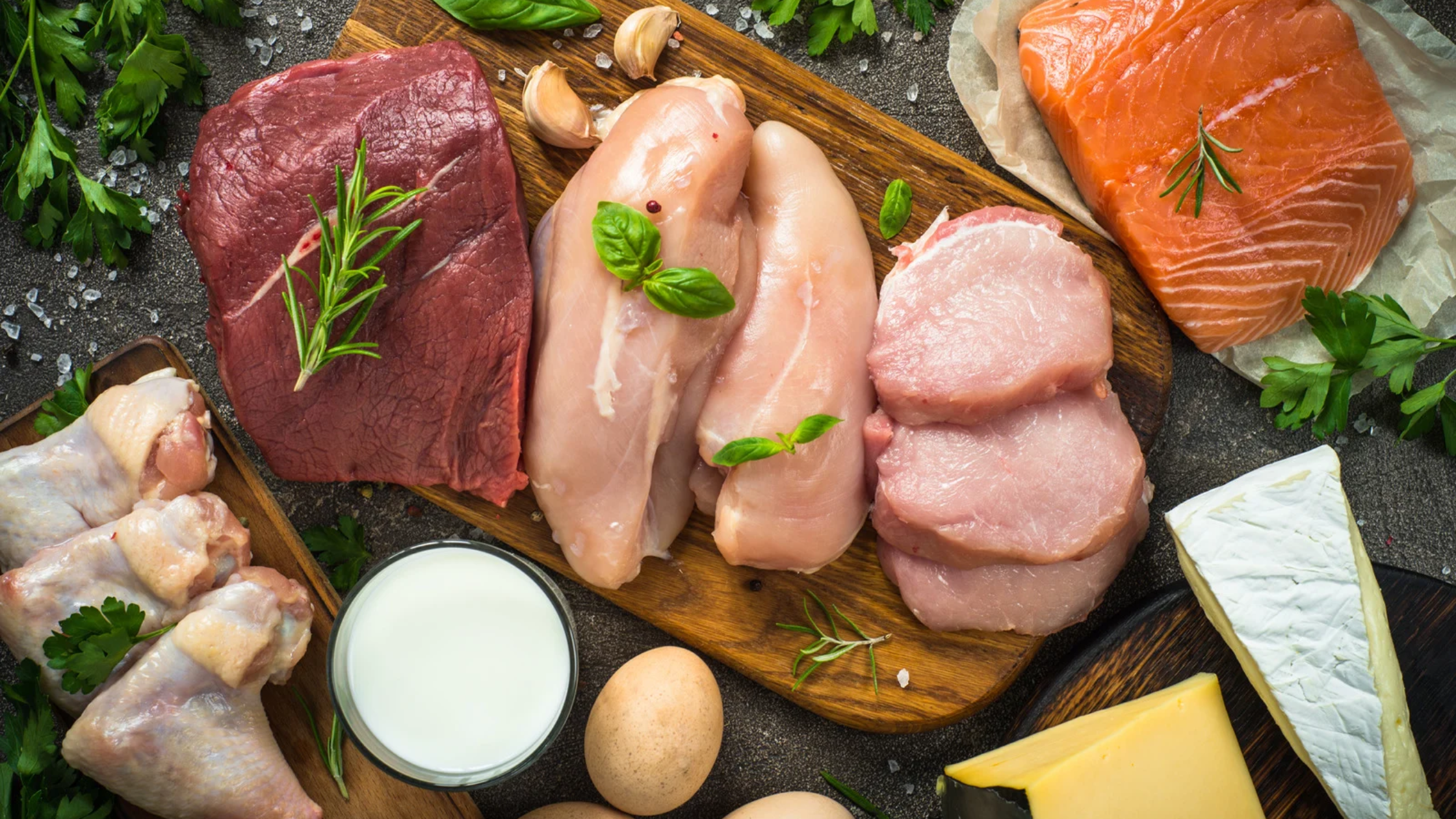
- Protein in meat per 100 grams
- Protein content in white meat
- Protein content in red meat
- Which meat contains the most protein
- Chicken and turkey
- Beef and horse meat
- Lean cuts of pork
- Meat protein table
- Lean, protein-rich meats for your diet
- Frequently asked questions
- Is eating meat every day good for your health?
- Which fattier meats should be limited?
- Which food has the most protein overall?
- How does the protein content of meat change after cooking?
Protein in meat per 100 grams
Meat is a source of high-biological-value protein because it provides all the essential amino acids that the body must obtain through food. The amount of protein in 100 grams is not the same for every type of meat: it depends on the animal species, the cut, the amount of fat, and whether the product is raw or cooked.
In general, 100 g of raw, fresh, lean meat provides approximately 20–24 g of protein. Chicken breast and turkey breast are at the upper end of this range, but beef, horse meat, and some lean cuts of pork can also provide similar amounts of protein.
Cooked meat may contain more protein per 100 g than raw meat, mainly because it loses water during cooking. This does not necessarily mean that new protein has been produced: the main change is in the food's weight.
Protein content in white meat
White meats, such as chicken and turkey, are often chosen by people who want to consume protein while limiting their fat intake. The actual content still depends on the cut: skinless breast, for example, is generally leaner than a thigh with skin.
Indicative values per 100 g of white meat include:
- Chicken breast: approximately 22–23 g of protein;
- Turkey breast: approximately 22–24 g of protein;
- Skinless chicken thigh: the amount varies depending on the cut and fat content;
- Rabbit: approximately 20 g of protein, with variations depending on the part considered.
Chicken breast and turkey breast are therefore among the most practical options for obtaining a good amount of protein while keeping fat intake relatively low, especially when lean cuts are selected and cooking methods that require large amounts of added fat are avoided.
However, evaluating a food based on its protein content alone is too simplistic: variety, portion sizes, preparation methods, and the overall quality of the diet also contribute to nutritional balance.
Protein content in red meat
Red meat includes several types, such as beef, veal, horse meat, pork, and lamb. Its protein content is generally similar to that of lean white meat, although it can vary significantly depending on the cut and amount of fat present.
Indicative values per 100 g of red meat include:
- Lean beef: approximately 21–22 g of protein.
- Veal: approximately 20–21 g of protein in several lean cuts.
- Horse meat: approximately 20–22 g of protein, depending on the cut.
- Lean pork: approximately 20–22 g of protein in cuts such as loin.
- Lean lamb: generally around 20 g of protein, with differences between cuts.
Red meat also provides micronutrients such as iron, zinc, and vitamin B12, but its nutritional profile varies from one food to another. To make an informed choice, it is useful to consider protein content alongside fat content, the cut, and consumption frequency.
It is therefore inaccurate to claim that all red meats contain more fat than white meats: a lean beef cut may contain less fat than a cut of chicken with the skin on. The composition depends primarily on the selected cut and preparation method.
Which meat contains the most protein
Among the main types of fresh, raw meat, turkey breast and chicken breast are among the most protein-rich choices, with indicative values that can reach approximately 23–24 g per 100 g, depending on the product and the nutritional data source consulted. Some lean cuts of beef, horse meat, and pork can also reach similar values.
However, there is no absolute answer that applies to every cut: protein content depends on the food's composition and water content. If dried products, such as dried meat, are included, protein values per 100 g can be much higher because dehydration concentrates the nutrients.
When choosing the meat best suited to your diet, consider not only the grams of protein but also fat, calories, micronutrients, and preparation methods.
Chicken and turkey
Chicken and turkey are among the most widely used protein sources in diets aimed at maintaining muscle mass or managing body weight. Skinless breast is particularly popular because it provides a good amount of protein and generally contains little fat.
From a nutritional perspective, these meats provide essential amino acids needed for protein synthesis in the body. They also contain other amino acids, including arginine, which is involved in several physiological processes.
The choice between chicken and turkey may depend on taste, cut, and preparation method. Both can be included in a varied diet and alternated with other protein sources such as fish, eggs, legumes and, according to individual needs, other types of meat.
To keep the meal's calorie content under control, it is also useful to pay attention to seasonings and cooking methods. Meat can be grilled, oven-roasted, or cooked in a non-stick pan using moderate amounts of added fat, and served with vegetables and other nutrient-rich foods.
Beef and horse meat
Beef and horse meat provide amounts of protein comparable to those found in many lean white meats. The exact content depends on the cut, but both can contribute to the daily intake of essential amino acids.
Beef is also a source of iron, zinc, and vitamin B12. Horse meat also provides protein and micronutrients, with fat content varying according to the cut. To compare these foods accurately, it is therefore advisable to check the nutritional values for the specific cut.
Beef and horse meat are also known for their naturally occurring creatine, a compound involved in muscle energy processes. The amount can vary according to the species, cut, and preparation method.
For a balanced diet, it is useful to alternate different protein sources rather than relying exclusively on red meat. Consumption frequency, portion sizes, and the other foods included in a meal all contribute to overall dietary quality.
Lean cuts of pork
Pork can be an interesting source of protein, especially when relatively lean cuts are chosen. Loin and some cuts from the leg, for example, can provide approximately 20–22 g of protein per 100 g, although the actual values vary according to the cut and visible fat content.
Not all cuts of pork have the same nutritional profile. Bacon, ribs, and certain particularly fatty cuts generally contain more fat and calories than lean loin. For this reason, the animal species alone is not enough to determine whether a food is suitable for a calorie-controlled diet.
It is also important to distinguish fresh meat from cured meats and other processed products. Ham, salami, sausages, and other pork products may have different nutritional values, partly because of their salt and fat content. A processed product should not be considered equivalent to a fresh cut simply because it provides a high amount of protein.
Meat protein table
The following table summarises the indicative protein content of selected fresh meats. The values refer to 100 g of raw edible portion and may vary according to the cut, fat content, and source of the nutritional data. They should not therefore be interpreted as universal values for every product on the market.
| Type of meat | Protein per 100 g | General characteristics |
|---|---|---|
| Raw turkey breast | Approximately 22–24 g | Generally a lean, protein-rich cut |
| Raw skinless chicken breast | Approximately 22–23 g | High protein content and little fat |
| Raw lean beef | Approximately 21–22 g | Source of protein, iron, and vitamin B12 |
| Raw lean veal | Approximately 20–21 g | Protein content varies depending on the cut |
| Raw horse meat | Approximately 20–22 g | Source of protein and micronutrients |
| Raw pork loin | Approximately 20–21 g | A cut that can offer a good balance between protein and fat |
| Raw leg of lamb | Approximately 20 g | Content varies according to the amount of fat present |
| Raw rabbit | Approximately 20 g | Meat that is generally rich in protein |
The table shows that the differences between lean fresh meats are not particularly large. Turkey and chicken are generally at the upper end of the range, but other cuts can also make a significant contribution to daily protein intake.
When comparing different foods, it is important to consider the portion actually consumed. For example, a 150 g portion of raw chicken breast provides approximately 33–35 g of protein, although the exact amount depends on the cut's composition and the weight considered.
Lean, protein-rich meats for your diet
Lean meats can help you meet your daily protein requirements without providing large amounts of fat, but the most suitable choice depends on individual needs, physical activity, and overall dietary habits. Chicken breast, turkey breast, lean beef cuts, and pork loin are some options to consider based on the product's nutritional values.
Meat does not necessarily need to be included in every meal as part of a balanced diet. It can be alternated with fish, eggs, dairy products, legumes, and other protein sources to vary nutrient intake and meal preparation. Protein requirements vary according to several factors, including age, weight, health status, and physical activity level.
People who exercise and want to maintain or develop muscle mass should consider not only the amount of protein per 100 g but also their total daily intake, how protein is distributed across meals, energy intake, and training consistency.
Meat protein is one of the available categories for people looking for an alternative protein source in powder form. Before choosing a product, it is useful to check the ingredients, nutritional values, and directions for use, without treating it as a necessary replacement for a varied diet.
Frequently asked questions
Is eating meat every day good for your health?
It depends on the type of meat, the amount consumed, and the rest of the diet. Meat provides important protein and micronutrients, but eating it every day is not necessary to meet protein requirements. Alternating it with fish, eggs, legumes, and other sources can help make the diet more varied.
It is useful to distinguish fresh meat from processed products such as cured meats and sausages. Dietary recommendations advise limiting processed meat consumption and moderating red meat intake as part of an overall balanced dietary pattern.
Which fattier meats should be limited?
Fat content depends mainly on the cut and preparation method, not just on the animal species. Options that are generally higher in fat include bacon, particularly fatty ribs, some cuts of lamb, and pork cuts with more visible fat. Chicken with the skin on can also contain more fat than skinless breast.
Cured meats and processed meats should be considered separately because they may contain significant amounts of salt and fat and have different nutritional characteristics from fresh meat. It is not necessary to judge a food solely by its category: the specific cut and its nutritional values are more useful for comparison.
Which food has the most protein overall?
There is no single food that holds the top position in every category, because the result depends on the criteria used: fresh or dried foods, animal or plant products, raw or cooked weight, and water content. Lean fresh meats often contain around 20–24 g of protein per 100 g, while some dried or highly concentrated foods can considerably exceed these values.
Among animal products, some aged cheeses and dried cured meats can provide a large amount of protein per 100 g. Dehydrated plant foods, such as certain flours and soy-based preparations, can also have a high protein content. These figures do not automatically indicate which food is best: fat, salt, calories, micronutrients, and usual portion sizes must also be considered.
Eggs are another source of high-quality protein that can easily be incorporated into a wide range of dishes. Rather than searching for the food with the highest absolute value, it is preferable to build a varied diet that provides adequate protein and the other nutrients the body needs.
How does the protein content of meat change after cooking?
Protein becomes more concentrated per 100 g of cooked meat than per 100 g of raw meat. The increase in protein relative to weight does not mean that cooking has created new protein: it is mainly a consequence of water loss.
For example, 100 g of raw meat may contain approximately 22–23 g of protein, while 100 g of the same meat after cooking may have a higher value. The result depends on cooking time and method, the cut, and the amount of water lost. For this reason, when comparing nutritional tables, it is important to check whether the values refer to raw or cooked food.
Dried meat is an example of a food in which dehydration concentrates nutrients relative to the final weight. However, it is also useful to check its salt content and other nutritional values.
Fresh lean meats generally provide approximately 20–24 g of protein per 100 g. Turkey and chicken are among the options with the highest values, but beef, horse meat, and lean cuts of pork can also make a significant contribution to protein requirements.
When choosing the most suitable meat, it is important to consider the cut, fat content, preparation method, and amount actually consumed. Alternating protein sources and maintaining a varied diet is more useful than focusing solely on the food with the highest protein content.


