- Health and wellness
- 62 views

- Recommended daily dose of vitamin K2
- The best time to take vitamin K2
- Foods rich in vitamin K2
- Contraindications and precautions for use
- Frequently asked questions
Recommended daily dose of vitamin K2
Vitamin K2, which belongs to the group of fat-soluble vitamins, is involved in several physiological processes, including normal blood clotting and bone metabolism. It is also known as menaquinone and differs from vitamin K1, or phylloquinone, in terms of its structure and distribution across food sources.
When discussing the daily dosage, it is important to distinguish between the overall vitamin K requirement and the amount of K2 contained in supplements. Available nutritional guidelines refer to vitamin K as a whole or, in the case of EFSA values, specifically to K1: there is no separate official requirement for K2 alone. Therefore, the 100 or 200 mcg doses found in supplements should not automatically be considered necessary for everyone.
Daily requirements and 200 mcg doses
According to the European Food Safety Authority (EFSA), the adequate intake of vitamin K for adults is 70 mcg per day. This value refers to phylloquinone, or vitamin K1, because the available evidence is insufficient to establish a specific reference value for menaquinones, including K2.
Consequently, it is not correct to consider 70 mcg the recommended daily dose of K2. Similarly, a dose of 200 mcg of vitamin K2, often found in supplements, represents a supplemental amount rather than a universal requirement. The choice depends on the formulation, individual characteristics and any recommendations from a healthcare professional.
The most commonly used forms of K2 in supplements include:
- MK-4 (menaquinone-4): a form found in some foods of animal origin, characterised by a relatively short presence in the bloodstream;
- MK-7 (menaquinone-7): a form found mainly in fermented foods such as natto, with a longer half-life than MK-4.
Vitamin K2 is involved in the activation of certain vitamin K-dependent proteins, including osteocalcin, which plays a role in bone metabolism. This process, known as osteocalcin carboxylation, enables the protein to bind calcium.
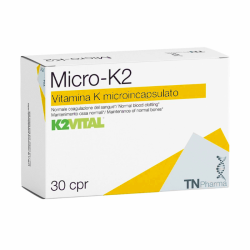
When choosing an MK-7 product, it may be useful to check the form and characteristics of the raw material used. Some formulations contain K2VITAL®, a raw material based on vitamin K2 in the menaquinone-7 form. However, the presence of a specific raw material does not mean that a particular dose is necessary for everyone or that it guarantees superior clinical results on its own.
Maximum dosage and risk of overdose
For vitamin K, including forms K1 and K2, no tolerable upper intake level (UL) has been established by the main scientific authorities. The available evidence has not made it possible to identify a precise threshold above which consumption necessarily causes adverse effects in the general population.
However, the absence of an official upper limit does not mean that taking high doses without a specific reason is advisable. Supplements can contain very different amounts of menaquinones, and there is no evidence that increasing the dosage produces proportional benefits for bone or cardiovascular health.
Before using high-dose products, it is therefore advisable to:
- check the amount of vitamin K2 contained in the daily serving;
- check whether you are already taking other supplements containing vitamin K;
- avoid combining several products without assessing your total intake;
- seek medical advice if you have any medical conditions or are taking medication.
Particular care is needed for people taking vitamin K antagonist anticoagulants, such as warfarin and acenocoumarol. In these cases, changing vitamin K intake through food or supplements may interfere with the treatment and requires medical assessment.
The best time to take vitamin K2
Vitamin K2 is fat-soluble, so it is absorbed together with dietary fats. For this reason, when taking a supplement, it may be practical to take it with a meal containing a source of fat.
There is no specific time of day that is considered best: taking it regularly and following the instructions on the label are more important than the time chosen.
Best time and taking it with meals
There is no specific time when vitamin K2 must be taken to achieve better absorption. It can be taken at breakfast, lunch or dinner, depending on your habits and the product instructions.
Since it is a fat-soluble vitamin, taking it with a meal containing fat may support its intestinal absorption. There is no need to choose specific foods or eat meals particularly high in fat: taking it with a balanced meal that includes, for example, extra virgin olive oil, nuts, eggs or other foods containing fats may be sufficient.
It is also useful to follow the manufacturer's instructions, as formulations may differ in composition and characteristics. Some supplements are available as capsules, while others come in drops or tablets: the format does not change the need to follow the indicated dose.
Combined supplementation with vitamin D3
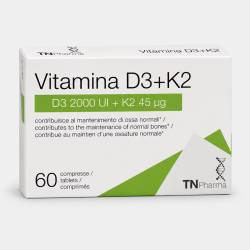
Vitamin K2 is often combined with vitamin D3 because both are involved in processes related to calcium metabolism and the maintenance of bone health, although they have different functions.
Vitamin D contributes to the normal absorption and utilisation of calcium and phosphorus and to the maintenance of normal bones. Vitamin K, on the other hand, is necessary for the activation of proteins such as osteocalcin, which is involved in bone mineralisation, and matrix Gla protein (MGP), which plays a role in regulating mineralisation processes in tissues.
These mechanisms explain the interest in combining the two vitamins, but they do not demonstrate that taking D3 and K2 together is always essential or that the combination automatically prevents osteoporosis, fractures or vascular calcification. The need to supplement both depends on dietary intake, nutritional status and individual circumstances.
Foods rich in vitamin K2
Vitamin K2 is found mainly in certain fermented foods and foods of animal origin. Unlike vitamin K1, which is abundant in green leafy vegetables, menaquinones are mainly associated with the activity of certain bacteria and fermentation processes.
Some of the most interesting dietary sources include:
- Natto: a traditional Japanese food made from fermented soybeans and one of the most concentrated sources of vitamin K2, especially in the MK-7 form;
- Aged and fermented cheeses: some varieties, particularly those subjected to longer fermentation processes, may contain significant amounts of menaquinones. The content varies according to the type of cheese and the microorganisms involved in its production;
- Egg yolk: contains vitamin K2, mainly in the MK-4 form, although the amounts are generally lower than those found in natto;
- Meat and organ meats: certain foods, such as liver and specific types of meat, provide varying amounts of menaquinones;
- Milk and dairy products: some dairy products can provide vitamin K2, but the content depends on the production process and type of food;
- Some fermented products: foods such as sauerkraut may contain small amounts of menaquinones, as well as vitamin K1.
The amount of vitamin K2 in foods is not always constant. It can vary according to the raw ingredients, the presence of specific bacteria, fermentation time and processing and storage methods. For this reason, it is not possible to assign a nutritional value to each food that applies in every situation.
It is also important not to confuse foods rich in vitamin K1 with those that mainly provide K2. Spinach, cabbage, broccoli and other green leafy vegetables are excellent sources of vitamin K, but they predominantly contain phylloquinone. A varied diet including vegetables, fermented foods and different protein sources therefore helps provide the various forms of this micronutrient.
Contraindications and precautions for use
Vitamin K2, in the amounts normally found in foods, does not present any particular contraindications for most people. Supplements are also generally well tolerated when used as directed, but there are situations in which particular care is needed.
The main precaution concerns interactions with vitamin K antagonist anticoagulants, such as warfarin and acenocoumarol. These medicines work by interfering with the vitamin K cycle, reducing the activation of certain clotting factors. A significant change in vitamin K intake may therefore alter the effect of the treatment and affect clotting values, such as the INR.
Anyone following this type of treatment should not start, stop or change their intake of vitamin K2 supplements without consulting their doctor first. It is also important to keep dietary vitamin K intake relatively consistent and avoid sudden changes in diet.
Other precautions concern:
- Pregnancy and breastfeeding: before using specific supplements, it is advisable to consult a doctor to assess whether they are actually needed and review the product composition;
- Medical conditions or medication: if you have any medical conditions or are undergoing ongoing treatment, it is best to check for possible interactions before starting supplementation;
- Taking several supplements at the same time: it is important to check labels to avoid unnecessarily combining products that contain vitamin K.
The absence of a tolerable upper intake level should not be confused with the possibility of taking any amount without precautions. High doses are not necessarily more effective and do not replace a balanced diet or any treatments prescribed by a doctor.
Frequently asked questions
Can taking vitamin K2 over a long period cause weight gain?
No, taking vitamin K2 over a long period does not directly cause weight gain. It is a fat-soluble vitamin that does not provide significant amounts of calories and does not, in itself, lead to an increase in body fat.
Vitamin K2 is involved in physiological processes related to blood clotting and bone metabolism, but it is not a nutrient that stimulates body fat accumulation. There is also no strong evidence that supplementation causes weight gain or weight loss.
Changes in body weight mainly depend on energy balance, eating habits, physical activity and various individual factors. Taking a K2 supplement therefore does not replace a balanced diet or represent a weight-loss strategy.
How long can vitamin K2 be taken continuously?
There is no universal maximum duration for taking vitamin K2 continuously. There are no standard cycles that apply to everyone, nor has it been demonstrated that supplementation must be stopped periodically to prevent the vitamin from accumulating.
The duration depends on the amount taken, the formulation, diet and any individual needs. Some people may achieve an adequate intake through their diet, while in other cases a supplement may be considered as part of a nutritional or healthcare plan.
Vitamin K2 is involved in important physiological processes, but there is no specific official daily dosage for this form of the vitamin. The 200 mcg amounts found in some supplements do not represent a universal requirement, just as no tolerable upper intake level has been established. It can be taken with a meal containing fat and is found mainly in fermented foods, cheese, eggs, meat and organ meats. Before starting supplementation, particularly over a prolonged period or in combination with vitamin D3, it is important to assess individual needs and consider possible interactions with anticoagulant medicines.