- Health and wellness
- 669 views
Why a stress-relieving plant is of interest to bodybuilders
Ashwagandha, known by its botanical name Withania somnifera, is classified as an adaptogen – a type of plant reputed to help the body cope with physical and mental stress. It is a mainstay of Ayurvedic medicine, where it has been used for centuries to promote vitality and resilience.
At first glance, its entry into the world of bodybuilding may seem surprising. What is an ‘anti-stress’ plant doing alongside creatine and protein?
The answer lies in one word: cortisol. This hormone, released in response to stress, has a catabolic effect; it promotes the breakdown of muscle protein. Intense training is in itself a physiological stressor, and when combined with insufficient sleep, a calorie deficit and work-related pressures, cortisol levels remain persistently high.
This is where ashwagandha comes into sports nutrition: not as a stimulant for muscle building, but as a potential countermeasure to what hinders it. This distinction is essential to understanding what we can expect from it.
Withanolides: the active fraction
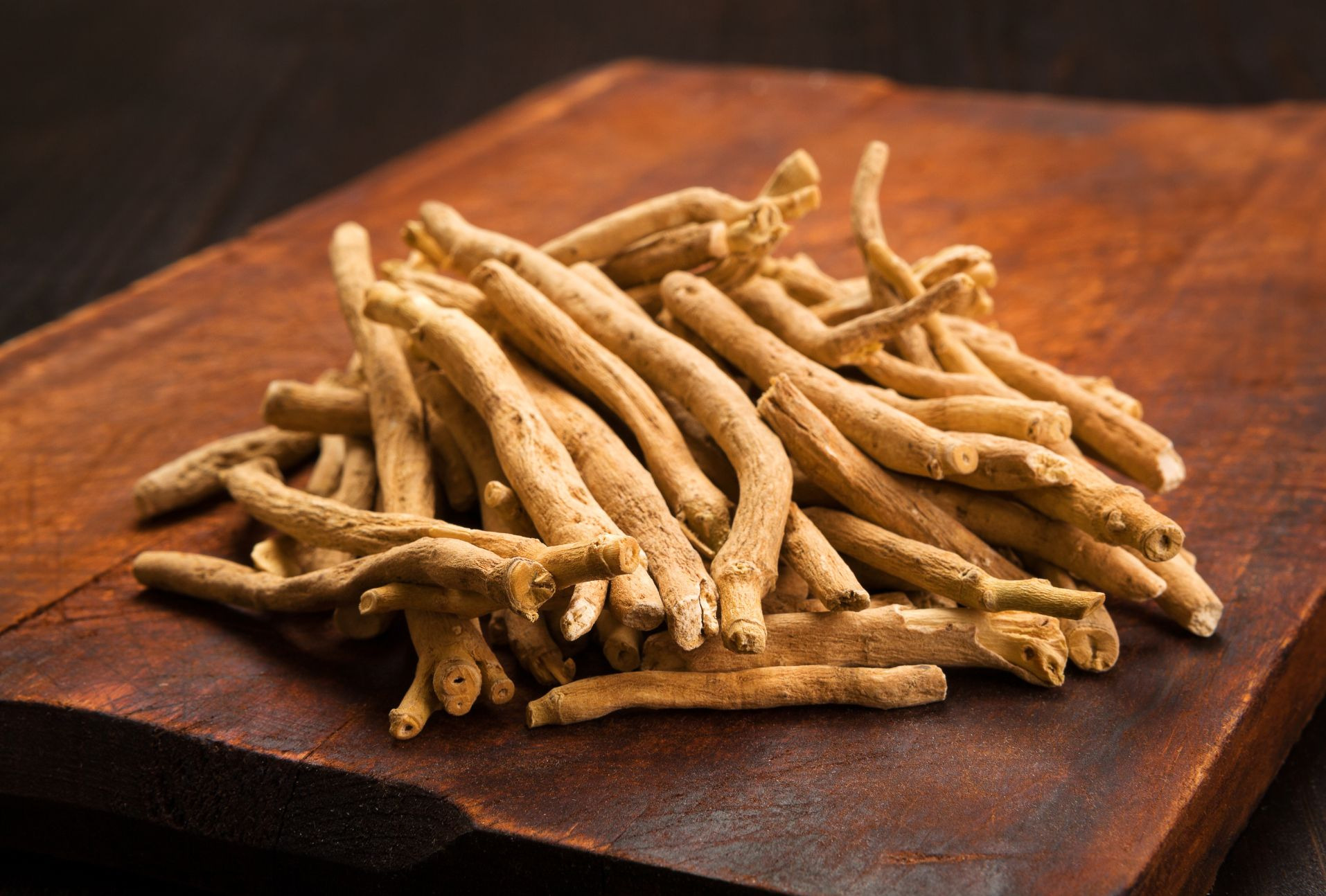
The compounds under study are withanolides, molecules found mainly in the root. Their concentration determines the extract’s activity, and this is the only criterion that allows two products to be compared with one another.
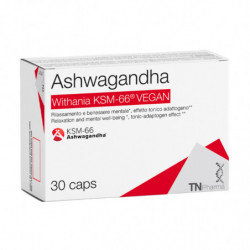
Two standardised extracts feature consistently in published research: KSM-66, derived from the root alone, and Sensoril, which combines root and leaves and has a higher withanolide content. The inclusion of a specific extract on the label, along with its percentage of withanolides, distinguishes a reputable product from a root powder of unknown composition.
Without standardisation, the quantity stated in milligrams is meaningless – a problem found across all plant extracts.
What research shows about strength and body composition
This is the area where ashwagandha has been most extensively studied in a sporting context, with more consistent results than for most plants marketed to athletes.
Several trials conducted on men following a weight-training programme reported, after eight to twelve weeks of supplementation:
- greater gains in strength during basic exercises compared with the placebo group
- a more pronouncedincrease in muscle mass
- a reduction in markers of muscle damage following exercise
- a reduction in serum cortisol
- an improvement in maximum oxygen uptake during endurance exercises
These results are encouraging, but should be viewed with two caveats. Sample sizes are often small, and several studies have been funded by manufacturers of the extracts, which does not invalidate the findings but calls for caution. Furthermore, no health claims have been approved in the European Union for ashwagandha, as the dossiers relating to these plants are still awaiting evaluation.
An important point to bear in mind: these benefits appear to be in addition to a structured training programme. None of the studies tested ashwagandha in sedentary individuals, and there is no reason to believe that it would produce any effects without the stimulus of exercise.
What about testosterone?
Some studies report a modest increase in testosterone, but mainly in men experiencing significant stress or fertility problems. In healthy individuals with normal levels, the observed effect is minimal.
The most honest interpretation is probably an indirect one: by reducing cortisol, ashwagandha improves a hormonal balance rather than increasing a specific hormone. This distinction is less marketable, but it better reflects what the data show. On the broader subject of plants marketed as hormonal stimulants, our article on Tribulus terrestris examines a case where the gap between claims and the evidence is far more pronounced.
Sleep: the most underestimated benefit
The plant’s species name, somnifera, is no coincidence. And for a practitioner, this is perhaps where the crux of the matter lies.
Several studies report an improvement in sleep quality and the time taken to fall asleep. Yet sleep is when recovery takes place: growth hormone secretion, tissue repair, and the consolidation of adaptation to training.
It is therefore plausible that some of the gains in strength observed in the studies are due to better sleep rather than a direct effect on the muscle. This hypothesis is consistent with the cortisol mechanism, as high cortisol levels and poor sleep are mutually reinforcing.
Practical implication: if you already get seven to eight hours of good-quality sleep, ashwagandha is likely to be of less benefit to you than if your sleep is disrupted by stress.
Dosage and administration
The protocols used in sports research range from 300 to 600 mg per day of standardised extract, which generally corresponds to one or two daily doses.
Some guidelines for use:
- Check the withanolide content rather than the total amount of extract. This is the only figure that is comparable across different products.
- Take with a meal to minimise digestive discomfort, which is common when taken on an empty stomach.
- The evening is often the best time, given its effect on sleep, unless you experience troublesome drowsiness during the day, in which case spread the doses out.
- Allow for a minimum of eight weeks. The effects described in the studies do not become apparent until several weeks of regular use.
- Plan for breaks. Data on very long-term continuous use are limited, and courses of two to three months interspersed with breaks are the most prudent approach.
Formulations designed to manage cortisol are grouped under the ‘cortisol control’ category.
A precaution to read before starting
Ashwagandha is often presented as risk-free, which is inaccurate. There are several serious contraindications (particularly in cases of thyroid disorders, autoimmune diseases, pregnancy or ongoing medical treatment), and safety concerns regarding the liver have led some European countries to restrict its sale.
This topic deserves to be addressed in its own right, and we have dedicated a full article to it: ashwagandha: risks and side effects. Please read it before starting a course of treatment, particularly if you are taking medication or suffer from a chronic condition.
Frequently Asked Questions
Does ashwagandha help build muscle?
Not directly. It has no anabolic effect of its own: it does not stimulate protein synthesis in the same way as amino acids or exercise itself.
The gains in muscle mass and strength observed in several studies occur via indirect mechanisms (reduced cortisol levels, better sleep, improved recovery) and always in conjunction with a structured strength training programme. Without training, there is no reason to expect any effect whatsoever.
When should you take ashwagandha – in the morning or in the evening?
Evening is often the most sensible choice, given its reported effects on sleep quality and the time taken to fall asleep.
If your main aim is to manage stress during the day, taking it both in the morning and in the evening is an option. In either case, take it with a meal: taking it on an empty stomach often causes digestive discomfort.
How long before you feel the effects?
Allow at least four weeks, and preferably eight to twelve weeks for effects on strength and body composition. Published protocols all cover this timeframe.
The effects on sleep and stress levels are generally noticed sooner, sometimes as early as the second or third week. A ten-day course is not long enough to observe either of these effects.
Can ashwagandha and creatine be taken together?
Yes, there are no known interactions between the two, and their mechanisms of action are completely distinct: creatine affects energy availability during explosive efforts, whilst ashwagandha influences the stress response and recovery.
This is a sensible combination for a regular exerciser, as each addresses an aspect that the other does not. Creatine remains by far the better-documented of the two in terms of pure performance, as highlighted in our selection of essential supplements for natural bodybuilders.
KSM-66 or Sensoril: which one should you choose?
Both are reputable standardised extracts, but they are not intended for exactly the same purpose. KSM-66, derived solely from the root, is the one that has been most widely used in studies on strength and body composition. Sensoril, which has a higher concentration of withanolides and includes the leaves, has been studied more extensively in relation to stress and sleep.
For training purposes, KSM-66 has the most extensive research backing. The key thing is that the label specifies the extract used, along with its percentage of withanolides.
Here’s what a proper course of treatment looks like, week by week: nothing for the first ten days – this is normal, and it’s at this stage that most people give up. Around the third week, sleep becomes slightly more restful and there is a reduced feeling of tension at the end of the day. Between the sixth and twelfth weeks, what the studies measure is faster recovery between sessions and slightly more consistent progress with training loads. If you’re expecting anything other than this, you’ll be disappointed, and if this is what you’re looking for, bear in mind that a good night’s sleep will already provide most of what you need, free of charge.