- Health and wellness
- 625 views

What are collagen peptides?
We often hear about them at the gym, in athletes’ posts or on supplement labels, and that’s because collagen really is everywhere – in the literal sense of the word. It is the most abundant protein in the human body: it is found in bones, cartilage, tendons, ligaments, skin and many other tissues.
Collagen peptides are fragments of this protein, produced through a process of hydrolysis which breaks down the long chains of amino acids into shorter, more easily absorbed segments. The result is a form of collagen that the gut can process much more efficiently than intact collagen, allowing the amino acids to be delivered directly to the tissues that need them.
What makes this type of supplement particularly interesting, especially for athletes, is that these fragments do not merely serve as a generic source of protein: certain specific peptides appear capable of stimulating collagen-producing cells (fibroblasts), thereby promoting the body’s own synthesis of new connective tissue.
To explore the link between collagen and structural health in greater depth, the section dedicated to bone and joint health in the Tsunami shop offers a comprehensive overview of the most suitable supplements in this area.
The difference between collagen and peptides
Collagen and collagen peptides are not the same thing, even though the two terms are often used interchangeably on supplement packaging.
- Collagen in its native form is a huge molecule, a triple helix of protein chains with a very high molecular weight. When consumed as it is, this structure is virtually indigestible: the gut is unable to absorb it and most of it is simply excreted. This is why homemade bone broth or edible gelatine, however useful they may be as sources of nutrients, do not guarantee the absorption of the desired bioactive peptides.
- Collagen peptides, on the other hand, have much shorter chains. This makes them water-soluble, stable at different temperatures and, above all, easily absorbed. They cross the intestinal barrier and enter the bloodstream in the form of dipeptides and tripeptides, where they can exert direct effects on target tissues.
Collagen peptides and hydrolysed collagen
When reading the labels of certain products, one notices that the terms ‘collagen peptides’ and ‘hydrolysed collagen’ are used interchangeably — and indeed they are, as they describe the same process: enzymatic hydrolysis, which breaks down collagen into short fragments. The difference lies rather in the quality of the hydrolysis and the degree of control over the molecular weight of the resulting fragments.
Not all hydrolysed collagens are created equal. The best products on the market specify the average molecular weight of the peptides (expressed in Daltons) and utilise patented hydrolysis technologies that ensure a uniform distribution of the peptide fractions — those identified by clinical studies as being the most bioactive. Verisol® hydrolysed collagen fits perfectly into this framework: a patented technology backed by clinical data on bioavailability as well as aesthetic and structural efficacy.
Benefits of collagen peptides
Collagen peptides are not a niche supplement reserved for people with joint problems. Their action affects a range of tissues and functions, from the skin to the muscles, including bones, tendons and ligaments. Here are the main benefits for which research has produced the most robust evidence.
Skin and tissue health
The best-known effect (and also the one supported by the largest number of studies) relates to the skin. Available studies suggest that collagen peptides taken orally may help to increase dermal density, improve skin hydration and reduce the depth of wrinkles.

This is precisely the approach taken by TN Pharma’s Skin and Nails, which combines Verisol® hydrolysed collagen—one of the most extensively studied patented ingredients for skin health—with hyaluronic acid, Kera-Diet® hydrolysed keratin, vitamin C and plant extracts.
This combination is designed to support the body’s natural production of collagen, improve the skin’s elasticity and hydration, and also contribute to the health of hair and nails. The inclusion of vitamin C is also particularly important, as it contributes to the normal formation of collagen and makes the formulation even more comprehensive.
To explore the impact of collagen on bone density in greater depth, the article on collagen for bones and osteoporosis offers a comprehensive guide to its benefits and recommended dosage.
Muscle mass development
Collagen peptides contain high levels of glycine, proline and arginine – amino acids which, when combined with exercise, appear to play a specific role in supporting muscle hypertrophy and recovery.
The most recent studies show that supplementation with collagen peptides, combined with resistance training, leads to greater gains in lean body mass than a placebo, with a particularly marked effect on the connective tissue component of muscle. It is not a substitute for complete proteins, but is a useful supplement, especially when the objective also includes maintaining the health of supporting structures.
To understand how protein fragments affect hypertrophy at a biochemical level, the guide on peptides in bodybuilding explains the mechanisms of action and the differences between the various categories of bioactive peptides.
Main types and combinations
Not all collagen peptides come from the same source, and not all sources have the same characteristics. The source influences the amino acid composition, the profile of bioactive peptides and the bioavailability of the finished product. It is worth knowing the main differences before making a purchase.
Characteristics of marine collagen
Marine collagen is extracted from the skin, scales or bones of saltwater or freshwater fish. Compared with bovine collagen (the other main source on the market), marine collagen has a lower average molecular weight, which results in greater bioavailability: the peptides are absorbed more quickly and reach the tissues in higher concentrations.
It is predominantly type I collagen, the most abundant form in the skin, tendons and bones, making it particularly suitable for those seeking benefits for these structures. Marine collagen is also the most common choice amongst those following a diet free from red meat or who prefer alternatives to beef or pork.
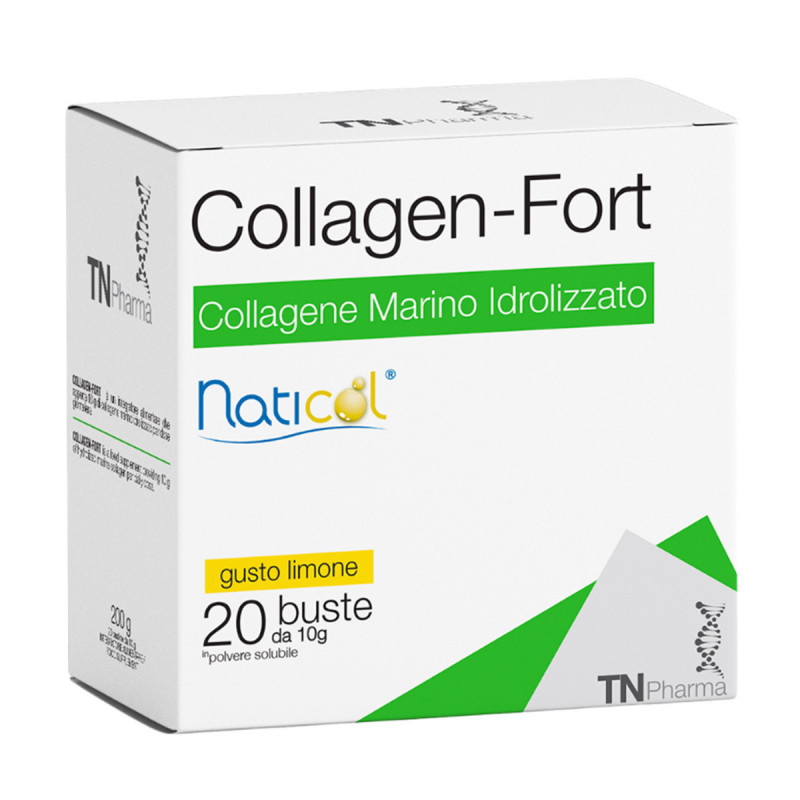
In our product range, TN Pharma’s Collagen-Fort is based on this principle: a patented hydrolysed marine collagen called Naticol®, one of the best-known and most extensively studied raw materials in the sector.
Thanks to the hydrolysis process, the collagen peptides have high bioavailability and are easily absorbed by the body, promoting the physiological renewal of connective tissue. The formula is designed to support the wellbeing of the skin, joints, tendons and bones, which is particularly beneficial when natural collagen production begins to decline – a phenomenon that generally affects people from the age of 30–35.
The product comes in handy single-dose sachets to be dissolved in water and is gluten-free and lactose-free, making it suitable for those with specific dietary requirements.
To explore the available options, our article on marine collagen – covering its benefits and contraindications – provides an overview of this raw material.
Synergy with vitamin C
Taking collagen peptides without vitamin C means missing out on a significant part of their potential. Indeed, vitamin C is an essential enzymatic cofactor for collagen synthesis. Without a sufficient intake of ascorbic acid, the enzyme that stabilises the collagen triple helix cannot function properly, and the production of endogenous collagen slows down, regardless of the amount of peptides consumed.
It is therefore worth taking collagen peptides alongside a source of vitamin C, whether this is a dedicated supplement or a food rich in ascorbic acid. Many combination products already incorporate this synergy into their formula, but if you choose a pure peptide, it is advisable to combine it deliberately. Vitamin C supplementation options are available in the Tsunami catalogue to complement the protocol in the most effective way.
Contraindications and precautions
Collagen peptides are generally well tolerated by most people. This product does not require any special precautions for healthy adults who engage in physical activity, but certain situations do warrant attention.
People with allergies to fish or shellfish should check the source of the collagen before purchasing: marine collagen may contain allergens from these groups.
In the case of kidney conditions, a significant additional protein intake may require medical advice. The same applies to people taking medicines that interfere with protein metabolism. One area warrants specific attention: the thyroid. People living with a thyroid disorder often wonder whether collagen might interfere with the gland’s function. The article on collagen and the thyroid addresses this question in detail, drawing on available data and offering practical advice for those undergoing hormone treatment. If in doubt, it is essential to seek advice from your GP.
How to choose the best collagen peptides
The market for collagen supplements is saturated and, as is often the case, quality varies enormously. Making an informed choice means looking beyond the packaging and assessing a few key factors.
The first is the source: marine or bovine, with an indication of the anatomical part from which it is extracted. The second is the type of hydrolysis and the stated molecular weight: the lower it is (below 5,000 Daltons), the better the bioavailability is in principle. The third is the presence of third-party certifications attesting to purity and the absence of contaminants. The fourth is the manufacturer’s transparency: reputable companies disclose the raw material, the manufacturing process and, where available, the clinical studies supporting the efficacy of their specific collagen.
It is best to be wary of products that simply state ‘hydrolysed collagen’ without providing any further details: this is the bare minimum and says nothing meaningful about the actual quality. You should prioritise formulas that combine peptides with vitamin C, a combination that makes sense both physiologically and commercially.
To help you navigate the most reliable options, the guide to the 5 best collagen supplements compares the most effective products based on the quality of their raw materials and the transparency of their formulations.
Frequently Asked Questions
When should you take collagen peptides?
The timing of intake is one of the most confusing aspects. The short answer is that the exact time matters less than consistency: taking collagen peptides every day, whatever the time, is far more important than trying to find the perfect ‘metabolic window’.
That said, there are a few practical guidelines. Taking them on a relatively empty stomach (in the morning with breakfast, or 30 to 60 minutes before a workout) may promote faster absorption. People who use them to support collagen synthesis in tendons and cartilage are best advised to take them around 30 to 60 minutes before physical activity: some researchers hypothesise that the availability of peptides in the blood during and immediately after mechanical loading may enhance the adaptive response of connective tissues. For full details on frequency, dosages and the ideal timing, the comprehensive guide on how to take collagen correctly answers all practical questions with advice tailored to different objectives.
Is collagen good for children?
Children naturally produce large amounts of collagen: this is one of the reasons why their skin is elastic, their bones grow continuously and their tissues regenerate much faster than in adults. Under normal health conditions, a child does not need an external supply of collagen: their body produces it independently and in more than sufficient quantities.
Collagen peptide supplementation is not recommended for healthy children without specific medical advice. This is not because collagen is dangerous, but simply becausethere is no physiological rationale to justify it at this age. In the event of a specific problem relating to bone growth, cartilage or connective tissue, it is up to the paediatrician or referring doctor to assess whether supplementation is necessary and, if so, how it should be administered, based on the individual clinical situation.